Table of Contents
Most B2B marketers treat ABM platforms like they’re all the same—another dashboard to check, another tool to manage. This guide breaks down what actually matters when you’re choosing one: the difference between platforms that just show you data versus ones that do the work, when ABM makes sense for your business, and why the future isn’t another dashboard you have to babysit.
An account-based marketing platform is software that helps B2B companies focus their marketing on a specific list of high-value target accounts instead of trying to reach everyone. This means you pick the exact companies you want as customers first, then use the platform to run campaigns aimed directly at them.
Think of it like this: traditional marketing is throwing a party and hoping the right people show up. ABM is sending personal invitations to exactly who you want at the table. The platform gives you the tools to find those people, reach them where they hang out online, and measure whether your efforts are actually turning them into customers.
Here’s what makes it different from the marketing tools you might already use. Your CRM tracks people after they become leads. Your marketing automation platform sends emails. An ABM platform sits on top of all that, helping you identify which companies to target, run ads to reach them across multiple channels, and connect every dollar you spend back to actual revenue.
Let’s be honest. You’re probably here because something isn’t working.
Maybe you’re burning through your ad budget on LinkedIn or Google, and half the clicks are from people who will never buy from you—not surprising when 79% of MQLs never convert into sales. Or your sales team keeps saying the leads are garbage. Or you’re stuck in spreadsheet hell, trying to manually build audiences and figure out which campaigns are actually worth the money.
Here’s when an ABM platform makes sense:
Your average deal size is big enough to justify the focus: If you’re selling a $50K+ product, it’s worth the effort to go after specific accounts. If you’re selling $500 subscriptions to thousands of customers, traditional demand gen might still be your best bet.
Sales and marketing are fighting: Marketing celebrates hitting their MQL target while sales complains about quality—a misalignment that costs businesses $1 trillion annually. An ABM platform forces both teams to focus on the same thing—winning specific target accounts.
You’re spending real money on ads: If you’re dropping $50K+ per month on paid channels, you need better targeting and attribution. An ABM platform helps you stop wasting budget on the wrong people.
You can’t prove ROI: Your CEO asks what marketing is doing to drive revenue, and you’re stuck showing them click-through rates and form fills. An ABM platform connects your ad spend directly to pipeline and closed deals.
If none of that sounds like you, save your money. But if you’re nodding along, keep reading.
Not all ABM platforms do the same thing. Some are glorified dashboards that show you data. Others actually help you execute. Here’s what the good ones include.
This is where everything starts. You need to know which companies to target before you spend a dollar on ads.
A solid platform pulls together multiple data sources to build a complete picture of each account. This includes firmographic data like company size and industry, technographic data showing what software they use, and intent data that tells you what topics they’re actively researching online. The best platforms also let you upload your own customer lists from your CRM to find similar companies or target specific segments.
Here’s why this matters: native ad platforms like Facebook and Google are built for B2C. They don’t understand the difference between a VP of Marketing at a Fortune 500 company and a college student researching a term paper. An ABM platform does. It lets you build audiences based on job titles, company revenue, tech stack, and buying signals—then deploy those audiences across channels that normally can’t target that way.
Orchestration means running coordinated campaigns across multiple channels so your target accounts see a consistent message everywhere they go.
Your buyers aren’t just on LinkedIn. They’re on Google, reading industry blogs, scrolling Reddit, and checking Facebook – B2B buyers now use an average of 10 channels throughout their buying journey. A good platform lets you manage campaigns across all those channels from one place instead of logging into a dozen different ad managers. This keeps your messaging consistent and your budget focused on the accounts that matter.
The key word here is “execution.” Some platforms just help you plan. The ones worth paying for actually launch and manage the campaigns for you.
Programmatic ABM is a fancy way of saying “automated ad buying targeted at your specific account list.”
Here’s how it works. You upload a list of 500 target companies. The platform finds employees from those companies as they browse the web and serves them your ads. This is how you make display advertising actually work for B2B—by only showing ads to people at companies you care about, not random internet users.
Without this, you’re stuck with LinkedIn’s native targeting, which is expensive and limited. With programmatic ABM, you can reach the same people on cheaper channels like Facebook, Instagram, or programmatic display networks.
This is where most platforms fall short, and it’s the most important part.
For years, marketers have been judged on clicks, impressions, and MQLs. Those metrics don’t pay the bills. A real ABM platform connects directly to your CRM and shows you how your ad spend influences pipeline and revenue. You should be able to see which accounts are engaged, which campaigns are moving deals forward, and what your actual return on ad spend is.
If a platform can’t tie ad dollars to closed deals, it’s just another reporting tool. You need attribution that connects the dots from first touch to closed-won.
Now that you know what to look for, here’s how to actually make a decision. Don’t just compare feature lists. Think about your team, your strategy, and what you’re trying to accomplish.
How does your company sell? If you’re running a high-velocity sales model with hundreds of deals per month, you need a platform that can handle volume and automation. If you’re doing enterprise sales with year-long cycles and $1M+ deals, you need deep account insights and the ability to run highly personalized plays.
Most platforms are built for one or the other. Pick the one that matches how you actually go to market, not how you wish you did.
Your ABM strategy is only as good as your data. Garbage in, garbage out.
Ask vendors where their data comes from. How often is it updated? Can they enrich your existing CRM data, or do you have to start from scratch? The best platforms combine third-party data with your first-party data to give you a complete view of each account.
If the data is stale or inaccurate, you’ll waste money targeting the wrong people at the wrong companies. Don’t skip this question.
Your buyers don’t live in one place. A platform that only supports LinkedIn limits your reach and makes you overpay for ads.
Look for a solution that covers:
LinkedIn (obviously)
Google Search and Display
Facebook and Instagram
Programmatic display networks
Emerging channels like Reddit or niche B2B networks
The more channels you can run from one platform, the more efficiently you can reach your target accounts.
Here’s where most platforms lie to you. They say they have “automation,” but what they really mean is you can schedule campaigns to turn on and off. That’s not automation. That’s a calendar.
True automation means the platform is working for you 24/7. It’s running thousands of small experiments—testing different audiences, ad copy, and bids—to figure out what works. It’s automatically shifting budget from underperforming campaigns to the ones generating pipeline. It’s adjusting in real time based on what’s happening in your CRM.
If you still have to log in every day to manually tweak campaigns, it’s not automated. It’s just another tool you have to babysit.
A new platform should make your life easier, not harder. It needs to integrate deeply with your CRM and marketing automation platform so data flows freely between systems.
If it doesn’t connect to Salesforce or HubSpot, you’ll spend half your time exporting CSVs and manually updating records. That defeats the entire purpose. Make sure the integrations are real, not just “we have an API you can use if you hire a developer.”
Understanding what good looks like is one thing. Finding a platform that actually delivers it is another. There are few names in ABM like 6sense and Demandbase both do parts of this well. 6sense excels at predictive analytics and identifying accounts by buying stage. Demandbase has strong B2B-specific advertising capabilities and account identification.
But both share a fundamental limitation: they’re built around intent signals – cookie data, site visits, keyword searches – that reflect how buyers used to research, not how they research today.
Modern B2B buyers bounce between ChatGPT, Reddit, LinkedIn, and dark social communities. They don’t leave the neat digital breadcrumbs that traditional intent models rely on. The result is signals that arrive late, incomplete, or pointed at the wrong accounts.
Both platforms also require significant manual work to operationalize – building audiences channel by channel, coordinating across GTM silos, and logging into multiple dashboards to manage campaigns. That’s not automation. That’s coordination with extra steps.
For the last decade, ABM platforms have been dashboards. They show you charts, graphs, and lists of accounts that are “in-market.” They tell you what’s happening, but you still have to do all the work—build the campaigns, write the ads, adjust the budgets, pull the reports.
That model is dead. Or at least it should be.
The future isn’t another dashboard. It’s an agentic platform – one where autonomous AI agents do the work for you. Instead of staring at a list of accounts showing intent signals, you give the system a goal. Something like: “Generate $500K in pipeline from enterprise SaaS companies in North America that use Salesforce.”
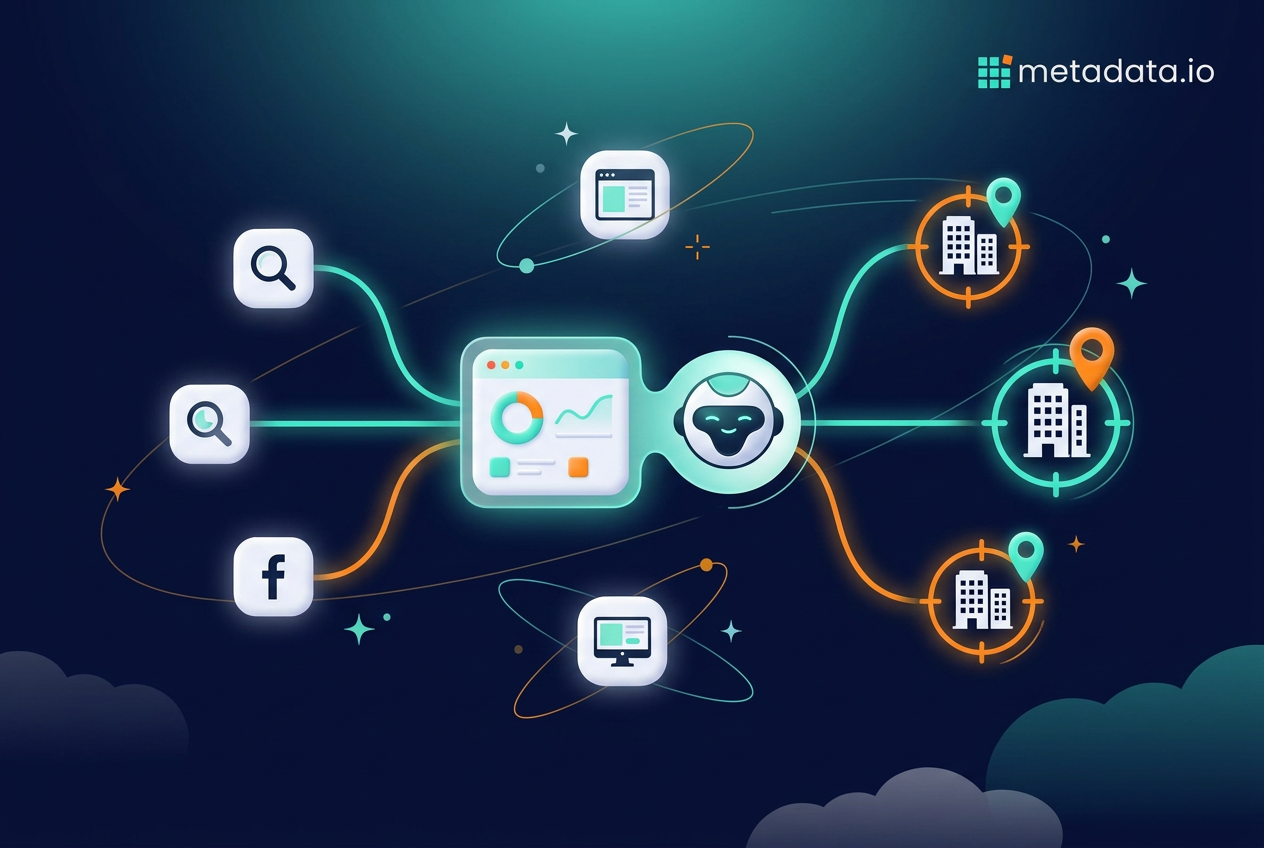
Then the AI agents get to work. One agent builds the audience using firmographic, technographic, and intent data. Another agent generates ad variations based on your brand guidelines and past performance. A third agent deploys campaigns across LinkedIn, Google, and programmatic channels. A fourth agent monitors results in real time and shifts budget to what’s working.
You’re not managing campaigns anymore. You’re setting goals and letting the system execute. It’s the difference between driving a car and telling a self-driving car where you want to go.
This is what Metadata has built with MetadataONE. It’s not a dashboard. It’s an agentic GTM platform that connects directly to ChatGPT and other LLMs through an MCP server connector. You can analyze your CRM data, build audiences, create campaigns, and optimize spend—all from a single conversation in the LLM you’re already using. No more logging into a dozen tools. No more spreadsheets. Just prompts to pipeline.
|
Capability |
6sense |
Demandbase |
RollWorks |
HubSpot ABM |
MetadataONE |
|---|---|---|---|---|---|
|
Intent data |
Strong |
Strong |
Yes |
Basic |
Any source |
|
Multi-channel ads |
Yes |
Yes |
Yes |
Partial |
Unified |
|
Campaign automation |
Assisted |
Assisted |
Assisted |
Assisted |
Autonomous |
|
LLM / chat control |
No |
No |
No |
No |
MCP native |
|
Budget optimization |
AI-assisted |
AI-assisted |
Manual |
Manual |
Auto 24/7 |
|
CRM attribution |
Yes |
Yes |
Limited |
Yes |
Pipeline-tied |
|
Audience building |
Per channel |
Per channel |
Per channel |
Basic |
Cross-channel |
|
Setup complexity |
High |
High |
Medium |
Medium |
One-click |
|
Designed for |
Prediction |
B2B ads |
SMB ABM |
CRM users |
Agentic GTM |
Here’s the truth: your job isn’t to be the best campaign manager or the most skilled spreadsheet user. Your job is to generate revenue for the business as efficiently as possible.
But most marketers are stuck in the weeds. They’re manually building audiences, A/B testing ad copy, adjusting bids, and trying to prove their value with vanity metrics like clicks and impressions. That’s not strategy. That’s busywork.
The right ABM platform changes that like Metadata. It automates the tactical work so you can focus on what actually matters – understanding your customer, crafting the right message, and aligning with sales to close deals. It connects your ad spend directly to pipeline and revenue so you can finally prove your impact.
If you’re tired of managing campaigns and ready to start driving real business results, it’s time to rethink your approach. Book a demo to see how an agentic GTM platform can help you go from prompts to pipeline.
Frequently Asked Questions (FAQ)
What is the difference between ABM and demand generation?
Can small businesses use account based marketing platforms?
How long does it take to see results from an ABM platform?
How much do ABM platforms typically cost?