
Table of Contents
Revenue marketing means tying every dollar you spend to actual pipeline and closed deals, not vanity metrics like lead counts or website traffic. This guide walks you through what revenue marketing actually is, how it’s different from demand gen, the metrics that matter, and how to build a strategy that connects your marketing work directly to money coming in the door.
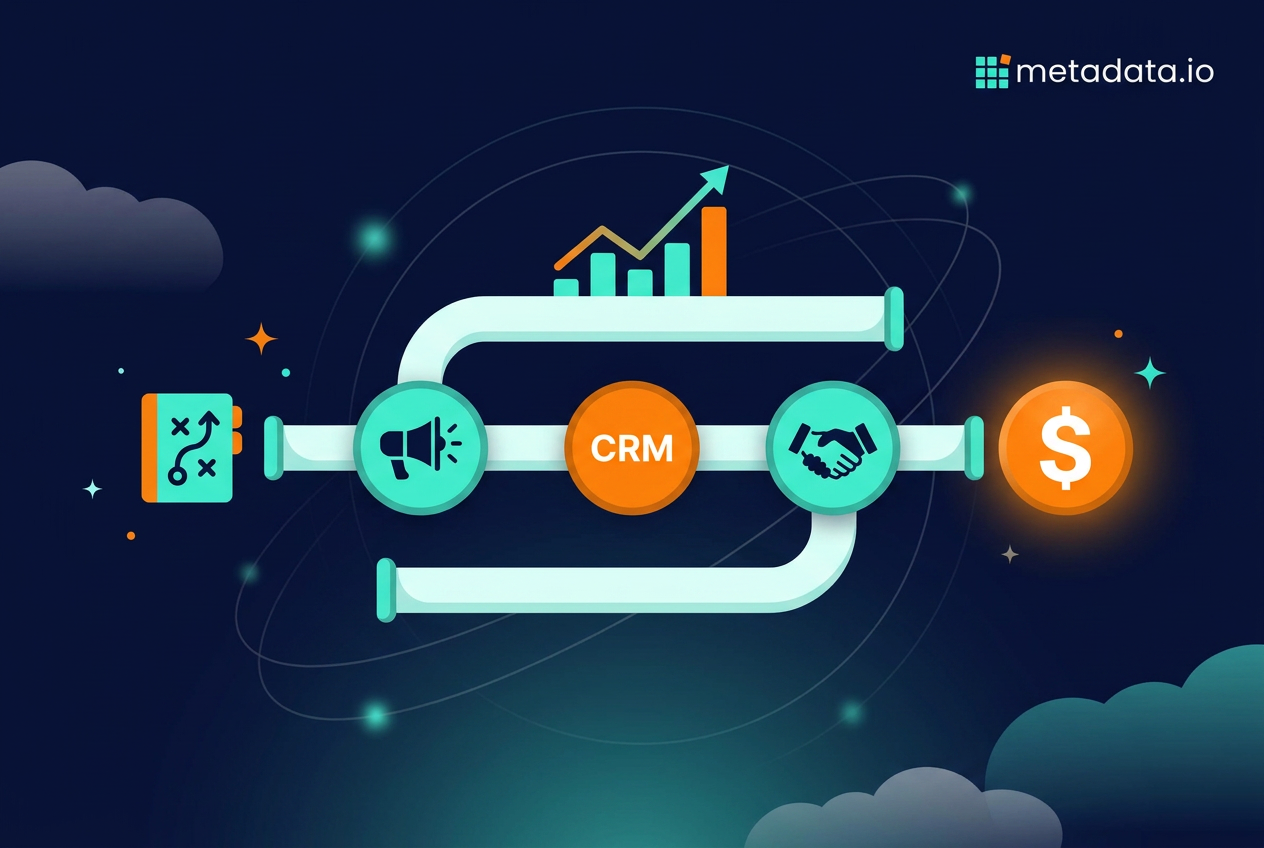
Revenue marketing is when you tie every marketing dollar directly to actual revenue. Instead of celebrating lead counts or website visits, you measure success by how much pipeline and closed revenue your marketing creates.
Think of it this way: traditional marketing says “we generated 500 leads this month.” Revenue marketing says “we influenced $2M in closed deals this quarter.” One sounds busy, the other sounds like a business.
This shift forces you to think like someone who actually cares about the P&L. Every campaign, every ad, every piece of content needs a clear line to money coming in the door. It’s less about looking productive and more about being profitable.
People throw these terms around like they mean the same thing. They don’t.
Demand generation is about creating interest and capturing leads. It’s a critical piece of the puzzle, but it’s just one piece. Revenue marketing takes the entire puzzle—from the first ad someone sees to the moment they become a paying customer to when they renew or expand—and makes sure every piece connects to revenue.
Here’s the real difference: demand gen teams celebrate when they hit their MQL target. Revenue marketing teams only celebrate when those MQLs turn into actual customers who pay actual money. It requires you to work closely with sales and customer success because you’re all chasing the same number.
|
Aspect |
Demand Generation |
Revenue Marketing |
|---|---|---|
|
Primary goal |
Generate qualified leads |
Generate predictable pipeline and revenue |
|
Key metrics |
Cost per lead, MQLs, conversion rates |
Customer acquisition cost, pipeline velocity, marketing-sourced revenue |
|
Focus |
Top and middle of the funnel |
The entire customer lifecycle |
|
Team alignment |
Primarily a marketing function |
Deep integration with sales and customer success |
You can’t just rename your dashboards and call it revenue marketing. You have to change how you actually work. Here are the principles that separate teams who talk about revenue from teams who actually drive it.
This is the hardest part and the most important. Real alignment isn’t a weekly meeting where marketing presents lead numbers and sales complains about lead quality.
It means both teams own the same revenue target. Marketing doesn’t get credit for hitting an MQL goal if sales misses quota. You win together or you lose together.
Here’s what actual alignment looks like:
Shared goals: Both teams are measured on the same pipeline and revenue numbers
Regular communication: Weekly meetings to review pipeline health, discuss specific accounts, and give honest feedback on what’s working
A service-level agreement: A formal document that defines what a qualified lead looks like and what sales commits to doing with those leads
Your job doesn’t end when you hand a lead to sales. Revenue marketers obsess over what happens after that handoff.
Are the leads you’re generating actually closing? Are they churning six months later? Are they buying more over time? These questions matter because they tell you if you’re bringing in the right customers, not just any customers.
This full-funnel view helps you spot problems early. Maybe your ads are generating tons of leads, but they’re all from companies too small to ever close. Or maybe you’re bringing in great customers, but they churn because the product doesn’t match what your marketing promised. You can’t fix these problems if you’re only looking at the top of the funnel.
If you can’t connect a marketing activity to pipeline or revenue, you should probably stop doing it. Clicks, impressions, and even lead volume are nice to know, but they’re not what keeps the lights on.
The metrics that matter are the ones your CEO and CFO care about. How much pipeline did marketing create? What’s our customer acquisition cost? How long does it take to close a deal? These are the questions that determine if marketing is seen as a profit center or a cost center.
This requires a solid attribution model. You need to know which channels, campaigns, and pieces of content are actually influencing deals. It’s messy work, but it’s the only way to prove your value.
Spray and pray doesn’t work in revenue marketing. You need to get specific about who you’re going after.
This means defining your ideal customer profile based on firmographics (company size, industry, location), technographics (what tools they use), and intent signals (are they actively looking for a solution like yours). Then you focus your entire budget on reaching those specific accounts.
It’s the difference between running ads to “all B2B marketers” and running ads to “B2B marketers at Series B SaaS companies with 50-200 employees who are currently using HubSpot.” One approach wastes money, the other makes money.
When you shift to revenue marketing, your dashboards need a complete overhaul. Here are the metrics that become your new scoreboard.
This is how much it costs you to acquire a single new customer. You calculate it by taking your total sales and marketing spend over a period and dividing it by the number of new customers you acquired in that same period.
A low CAC means you’re efficient. A high CAC means you’re either targeting the wrong people, your sales cycle is too long, or your conversion rates are terrible. Either way, you need to fix it.
LTV is the total revenue you can expect from a customer over their entire relationship with you. It’s critical because it tells you how much you can afford to spend to acquire a customer.
A healthy business has an LTV that’s at least three times higher than CAC. If your LTV is $100K and your CAC is $40K, you’re in trouble. If your LTV is $100K and your CAC is $20K, you’re printing money.
This measures how fast deals move through your pipeline and how much value they represent. The formula is: (number of opportunities × average deal size × win rate) ÷ length of sales cycle.
Increasing pipeline velocity means you’re generating revenue faster. You can do this by creating more opportunities, increasing deal sizes, improving win rates, or shortening your sales cycle. Revenue marketers obsess over all four.
This is the bottom line. It’s the portion of closed-won revenue that came directly from marketing’s efforts—whether that’s a paid ad, a webinar, an email campaign, or a piece of content.
This metric proves marketing isn’t just a support function. It shows you’re directly contributing to the number that matters most: revenue.
There’s no magic number that works for everyone. But there are benchmarks you can use as a starting point.
Most established B2B companies spend between 5% and 12% of total revenue on marketing. High-growth startups or companies entering new markets often spend 20% or more. The right number for you depends on a few things:
Your growth stage: Early-stage companies need to spend more to build awareness and grab market share
Your industry: Competitive markets require higher spend just to be heard
Your business goals: Are you optimizing for steady growth or trying to grow fast? Your budget should match your ambition
The key is treating your marketing budget as an investment, not an expense. As long as you’re tracking CAC and LTV, you can make a clear business case for your budget based on the return it generates.
You can’t run revenue marketing on spreadsheets alone. You need tools that connect your data and automate the repetitive work. Here’s what you actually need.
Your CRM is where all your customer and prospect data lives. It tracks contacts, accounts, opportunities, and deals. Platforms like Salesforce or HubSpot are the foundation because they give sales and marketing a single source of truth.
Without a solid CRM, you’re flying blind. You can’t track which leads are turning into customers, which campaigns are working, or how long deals take to close.
This is where you manage email campaigns, landing pages, and lead nurturing. Tools like HubSpot, Pardot, or Marketo help you engage prospects at scale and move them through the funnel until they’re ready to talk to sales.
Marketing automation also tracks how prospects interact with your content, which helps you score leads and prioritize the ones most likely to buy.
This is where strategy meets execution. An agentic go-to-market platform connects your CRM, marketing automation, and ad channels into one system.
Instead of manually building audiences, testing creative, and adjusting bids across multiple platforms, AI agents do it for you. They run thousands of experiments to figure out what’s working and automatically move budget to the campaigns generating pipeline. You set the strategy, and the agents handle the execution.
This is the difference between spending your days in spreadsheets and actually having time to think strategically about your business.
For years, revenue marketing meant more work. More reports, more spreadsheets, more time adjusting campaigns in five different ad platforms.
That era is ending. The future of revenue marketing is autonomous.
Instead of manually testing audiences and creative, you define your strategy and let AI agents execute it. These agents work around the clock, testing variations and moving budget to what’s actually generating pipeline. They’re faster, more consistent, and they don’t get tired.
This frees you from the tactical weeds. You stop being a campaign manager and start being the architect of a revenue engine. You focus on strategy, messaging, and understanding your customer—the things that actually require human judgment.
The marketers who figure this out first will have an unfair advantage. They’ll move faster, waste less budget, and generate more pipeline than their competitors. And they’ll do it without burning out their teams.
Frequently Asked Questions (FAQ)
What tools do I need to start revenue marketing?
How long does it take to see results from revenue marketing?
Can small marketing teams implement revenue marketing?
What's the difference between revenue marketing and account-based marketing?
How do I convince leadership to invest in revenue marketing?
What attribution model works best for revenue marketing?