Table of Contents
Identity resolution is how you figure out that the anonymous website visitor, the webinar lead, and the contact in your CRM are all the same person—then use that knowledge to stop wasting ad spend and actually prove what’s working. This guide breaks down what it is, how it works, and why it’s the difference between guessing who your buyers are and actually knowing.
Identity resolution is the process of connecting all the different pieces of data you have about a person into a single, unified profile. This means figuring out that the anonymous visitor on your website, the lead from a webinar, and the contact in your CRM are all the same human being.
Think of it like being a detective. You find a business card here (a work email), a partial fingerprint there (a browser cookie), and a witness description over there (a LinkedIn profile click). Identity resolution connects those clues to create one profile for one person, not three profiles for three strangers.
For B2B marketers, this isn’t just a neat data trick. It’s the foundation for spending your budget intelligently and actually knowing who you’re talking to.
Your customer data is probably a mess. People use different emails, browse on their phone and laptop, and show up in your systems in a dozen different ways. You’re flying blind, trying to market to fragments of people instead of whole accounts.
This fragmentation leads to some expensive problems:
And with third-party cookies going away, relying on ad platforms to connect the dots for you is a losing game. The problem is only getting worse. Ignoring it means you’re choosing to be inefficient.
So how does the magic happen? It’s not magic, it’s just a combination of data and smart algorithms. The process generally boils down to two main methods for identity matching.
Deterministic matching is the most accurate method. It connects profiles using a known, unique identifier that you know belongs to a specific person. Think of it as a fingerprint match—it’s a sure thing.
These identifiers are typically first-party data that you own and have collected with consent. The most common ones are email addresses, user IDs from your product login, and phone numbers. When someone gives you their work email on a form and then logs into your product with that same email, you know for certain it’s the same person.
The upside is accuracy. The downside is limited reach. You can only make a deterministic match if you have that person’s email or user ID, which you won’t have for anonymous website visitors.
Probabilistic matching is where things get interesting. It uses statistical modeling and algorithms to make a highly confident, but not 100% certain, guess that two or more digital signals belong to the same person. It’s more like a detective making a deduction based on a collection of clues.
This method looks at non-personal data points that, when combined, create a unique signature. Things like IP address, device type and operating system, browser type and version, location data, and time of day activity. When someone visits your site from a specific IP address on a MacBook using Chrome at 2pm, and then later that day someone from the same IP visits on an iPhone using Safari, there’s a high probability it’s the same person.
Modern identity resolution platforms often use AI to analyze thousands of these signals in real-time. This makes the “educated guess” of probabilistic matching incredibly accurate and allows you to understand the behavior of users even before they give you an email address.
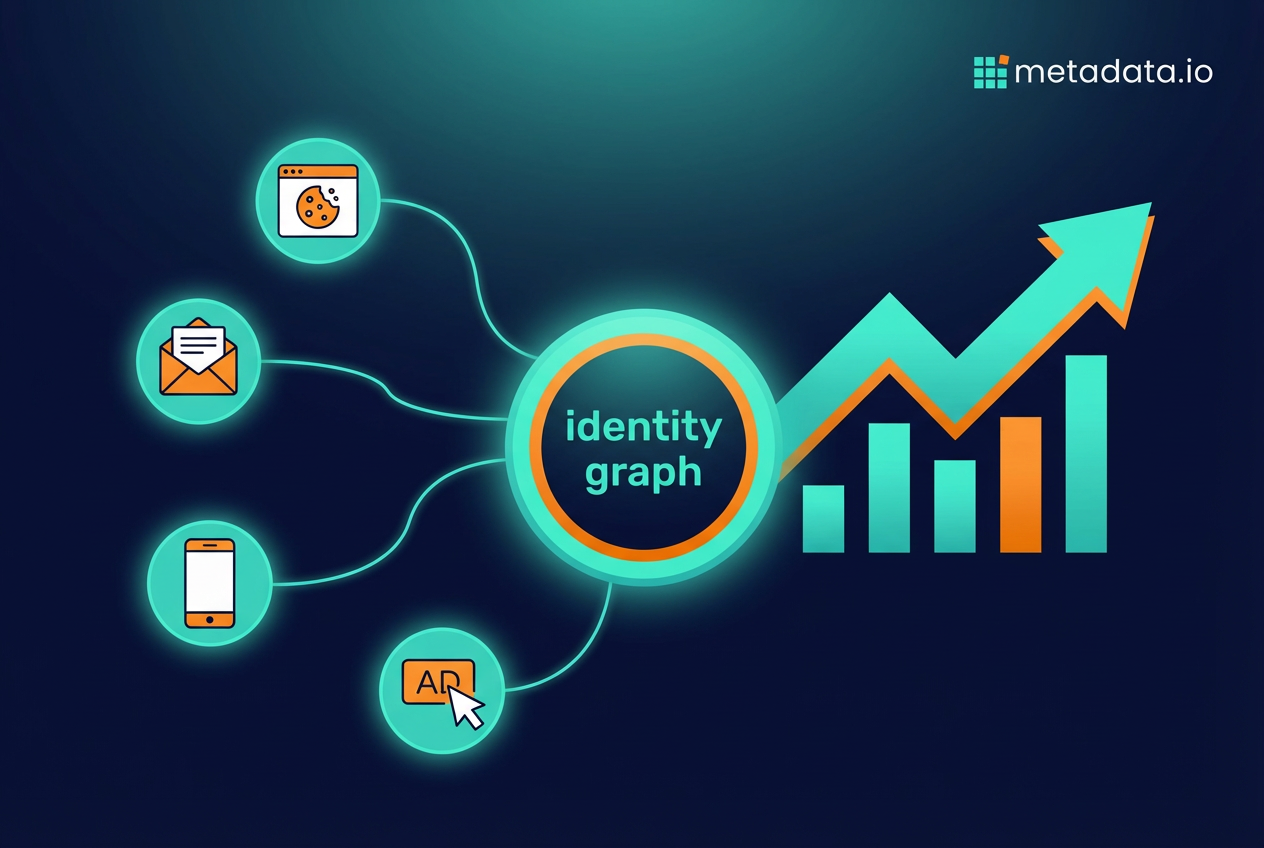
All of this resolved data needs a place to live. That place is called an identity graph. It’s the central database that stores and links all the identifiers and data points for each individual profile.
A customer identity graph doesn’t just store data; it creates connections. It’s the web that links a person’s work email, personal email, phone device ID, and laptop cookie all back to a single, persistent profile. When Jane Doe visits your pricing page on her phone during lunch, then fills out a demo form on her work laptop that afternoon, the identity graph knows it’s the same Jane.
| Identifier Type | Example Data Point | Connected To |
|---|---|---|
| Known PII | jane.doe@company.com | Jane Doe Profile |
| Device ID | Mobile Ad ID: 384-294-924 | Jane Doe Profile |
| Browser Cookie | Cookie ID: 8c91b2… | Jane Doe Profile |
| Behavioral Data | Visited /pricing page | Jane Doe Profile |
This shows how different touchpoints, both known and anonymous, are stitched together. It’s your company’s single source of truth for who your buyers are and how they interact with you.
Okay, so you have a clean, unified view of your buyers. So what? How does that translate into hitting your numbers? This is where the theory meets the road and turns into actual revenue.
This is the most immediate and satisfying return. With a clear view of who is who, you can build suppression lists to stop showing ads to people who shouldn’t see them.
You can exclude:
Every dollar you don’t spend on an irrelevant audience is a dollar you can reinvest in reaching net-new accounts. If you’re spending $100K a month on ads and 15% of that is going to the wrong people, that’s $180K a year you’re lighting on fire.
“I know half my marketing spend is wasted; the trouble is I don’t know which half.” Identity resolution helps solve this age-old problem. By connecting a user’s journey across devices and channels, you can finally see that the person who clicked a LinkedIn ad on their phone is the same person who later requested a demo on their laptop.
This allows you to build attribution models that reflect reality, not just the last click. You can confidently report on what’s actually working. When your CEO asks which campaigns are driving pipeline, you’ll have an answer that isn’t just a guess.
When you know who you’re talking to and where they are in their journey, you can deliver ads and content that are actually relevant. Instead of showing a top-of-funnel “What is X?” ad to someone who has already visited your pricing page, you can serve them a compelling case study or a special demo offer.
This relevance leads directly to higher engagement and better conversion rates. Which means a lower customer acquisition cost. Which means you hit your pipeline targets without needing to beg for more budget.
No one likes being treated like a stranger by a company they’re actively evaluating. Identity resolution prevents the disjointed experience of getting introductory emails after you’ve already spoken to sales. It ensures a smooth, coherent journey for the buyer, which reduces friction and helps your sales team close deals faster.
When a prospect feels like you actually know them and remember their interactions with your brand, they trust you more. Trust closes deals.
For B2B marketers, the real power of identity resolution is unlocked when you apply it to your paid campaigns. It moves you from channel-specific tactics to a true audience-first strategy.
Here’s the dream: build a hyper-specific audience using firmographic data, technographic signals, and your own first-party CRM data. Then reach those exact people not just on LinkedIn, but also on platforms like Meta, Reddit, or through programmatic display.
This is the power of advertising identity. You get LinkedIn-level targeting precision everywhere you advertise, without being trapped in one platform’s walled garden. You can target a VP of Marketing at a Series B SaaS company who uses Salesforce and has visited your site in the last 30 days—and reach them on Facebook while they’re scrolling at night.
Most B2B marketers think precise targeting only exists on LinkedIn. That’s not true anymore. Identity resolution makes it possible to bring your B2B audience targeting to traditionally B2C platforms, where the CPMs are often much cheaper.
ABM is all about focusing on high-value accounts, but it falls apart if you can only identify one or two people within that account. Identity resolution helps you uncover more contacts within your target account list.
It connects the dots between the known decision-maker and the anonymous researchers on the buying committee. This ensures your message blankets the entire account, not just one person. You’re not just reaching the VP who filled out a form. You’re also reaching the Director who’s been quietly reading your blog posts and the Manager who watched your webinar.
An identity resolution platform can feed rich engagement data back into your CRM. When a lead from a target account clicks an ad or visits a key page, that activity can be logged on their contact record in Salesforce.
This gives your sales team incredible context for their outreach. Instead of a cold call, they can reference the exact problem the prospect is researching. “Hey, I noticed you’ve been checking out our integration with HubSpot—want to see how that works?” That’s a warm, relevant conversation that actually moves deals forward.
This all sounds great, but it’s not a magic button. Being the no-BS friend, it’s important to tell you it’s not always easy.
Data quality is everything. The old saying “garbage in, garbage out” is brutally true here. If your source data is a mess of typos, outdated information, and duplicates, your identity graph will be unreliable. A clean data foundation is non-negotiable. You can’t resolve identities if you can’t trust the data you’re starting with.
Privacy and consent matter. You’re dealing with customer data, which means you have to be serious about privacy. Ensuring your data collection and matching processes are compliant with regulations like GDPR and CCPA is critical. Transparency with users is key. You need to be clear about what data you’re collecting and how you’re using it.
Choosing the right tech is complex. The market is full of identity resolution software and identity resolution providers, from massive CDPs to specialized tools. Finding the right fit that integrates with your existing stack and solves your specific B2B advertising problems takes time. Not every solution is built for B2B. Some are designed for e-commerce or media companies and won’t give you the firmographic and technographic targeting you need.
Many marketers hear “identity” and immediately think of cookies. But as third-party cookies disappear, identity resolution is becoming more, not less, important. The future of marketing is built on first-party data—the data you collect directly from your audience.
Identity resolution is the engine that makes your first-party data powerful. It allows you to take the consented data you have (like email signups) and use it to better understand and reach your audience across the web. It’s the solution to the cookie problem, not a casualty of it.
Third-party cookies were always a crutch. They were never that accurate for B2B anyway because they tracked devices, not people, and they definitely didn’t track accounts. First-party data, when properly resolved, is far more valuable. You know who these people are, what company they work for, and what they actually care about.
At the end of the day, identity resolution is about one thing: certainty. It’s about moving from guessing who your buyers are to knowing. It’s about shifting from hoping your ads are working to proving they are.
It’s about making your ad spend work smarter, not harder. It’s about freeing yourself from low-value work, restless nights worrying about targets, and endless spreadsheets. It’s time to fall in love with marketing again.
Frequently Asked Questions (FAQ)
What is the difference between identity resolution and a CDP?
Is identity resolution compliant with GDPR and CCPA?
How do I choose an identity resolution platform?
How much does identity resolution software cost?