Table of Contents
Most B2B marketers calculate marketing automation ROI wrong because they count vanity metrics like email opens and CPLs instead of actual pipeline and revenue. This guide shows you how to measure what really matters, which strategies actually improve your returns, and how AI changes the entire game by running thousands of experiments and optimizing your ad spend in real time.
Marketing automation ROI is the money you make from your automation systems compared to what you spend on it. This means if you spend $100,000 on a platform and it generates $500,000 in new revenue, you’ve got a 400% return.
Most marketers think ROI is about “time saved” or “efficiency gains” – which also matter. But your CFO doesn’t care about that. They want to know if the money spent on marketing automation is creating actual revenue or just making your team feel busy.
Real marketing automation ROI connects your campaigns directly to closed deals. It’s the difference between saying “we sent 50,000 emails this month” and “we generated $2 million in pipeline this month.” One is activity. The other is results.
The math itself is simple. The hard part is being honest about what you’re actually spending and what you’re actually gaining.
Take the revenue you gained from automation, subtract what it cost you, then divide by the cost. Multiply by 100 to get a percentage.
Here’s what it looks like: [(Gain from Investment - Cost of Investment) / Cost of Investment] x 100
So if your automation generated $500,000 in pipeline and cost you $100,000 total, you’d calculate it like this: [($500,000 - $100,000) / $100,000] x 100 = 400%
That’s a 400% return. For every dollar you spent, you got four dollars back.
This is where most marketers screw up the calculation. They only count the platform subscription and forget everything else. That makes their ROI look way better than it actually is.
Your real costs include:
If you’re spending $50,000 a month on LinkedIn ads through your automation platform, that’s $600,000 a year in costs you need to count. Don’t just count the $30,000 platform fee and call it a day.
Gains are more than just closed revenue. A good automation platform creates value in multiple ways, and you should count all of them.
Let’s say your automation helped create $3 million in new pipeline, and historically 30% of your pipeline closes. That’s $900,000 in expected revenue. If your total costs were $150,000, your ROI is 500%.
Your ROI calculation is only as useful as the metrics you put into it. Most B2B marketers track things that make them look productive but tell them nothing about whether they’re actually making money.
These metrics feel good to report in meetings. They make it look like you’re doing something. But they don’t prove you’re contributing to revenue.
Don’t get me wrong, these are still important to track – but they shouldn’t be your north star. Here’s the problem. You can have 10,000 MQLs and generate zero pipeline. You can have a 40% email open rate and still miss your revenue target. These metrics measure activity, not outcomes.
These are the numbers that prove your marketing automation is worth the investment. They connect what you’re doing directly to money in the bank.
If you can walk into a meeting and say “our automation generated $5 million in pipeline last quarter at a CAC that’s 30% lower than last year,” you’ve got a real story. That’s ROI.
Getting a positive ROI isn’t about buying a tool and hoping for the best. It’s about changing how you work. Here’s what actually moves the needle.
The fastest way to waste money is targeting the wrong people. Most ad platforms have terrible B2B targeting, so you end up paying to reach people who will never buy from you.
The fix is simple. Define your Ideal Customer Profile and only target accounts that match it. Use your CRM data to build audiences of companies that look exactly like your best customers. Then find those people on whatever channel makes sense—LinkedIn, Meta, Google, wherever.
This is how you stop spending $10,000 to generate 500 leads that sales ignores. Instead, you spend $10,000 to reach 500 accounts that actually fit your ICP.
If you can’t see which campaigns are generating pipeline, you’re guessing. And guessing is expensive.
Your automation platform needs to integrate directly with your CRM. This creates a closed loop where you can track someone from the first ad they clicked all the way to the deal they closed. Then you know exactly which campaigns, ads, and audiences are worth your budget.
Without this connection, you’re just hoping your ads work. With it, you know they work.
A human can run maybe three A/B tests a month. That’s slow. And it means you’re leaving a ton of performance on the table.
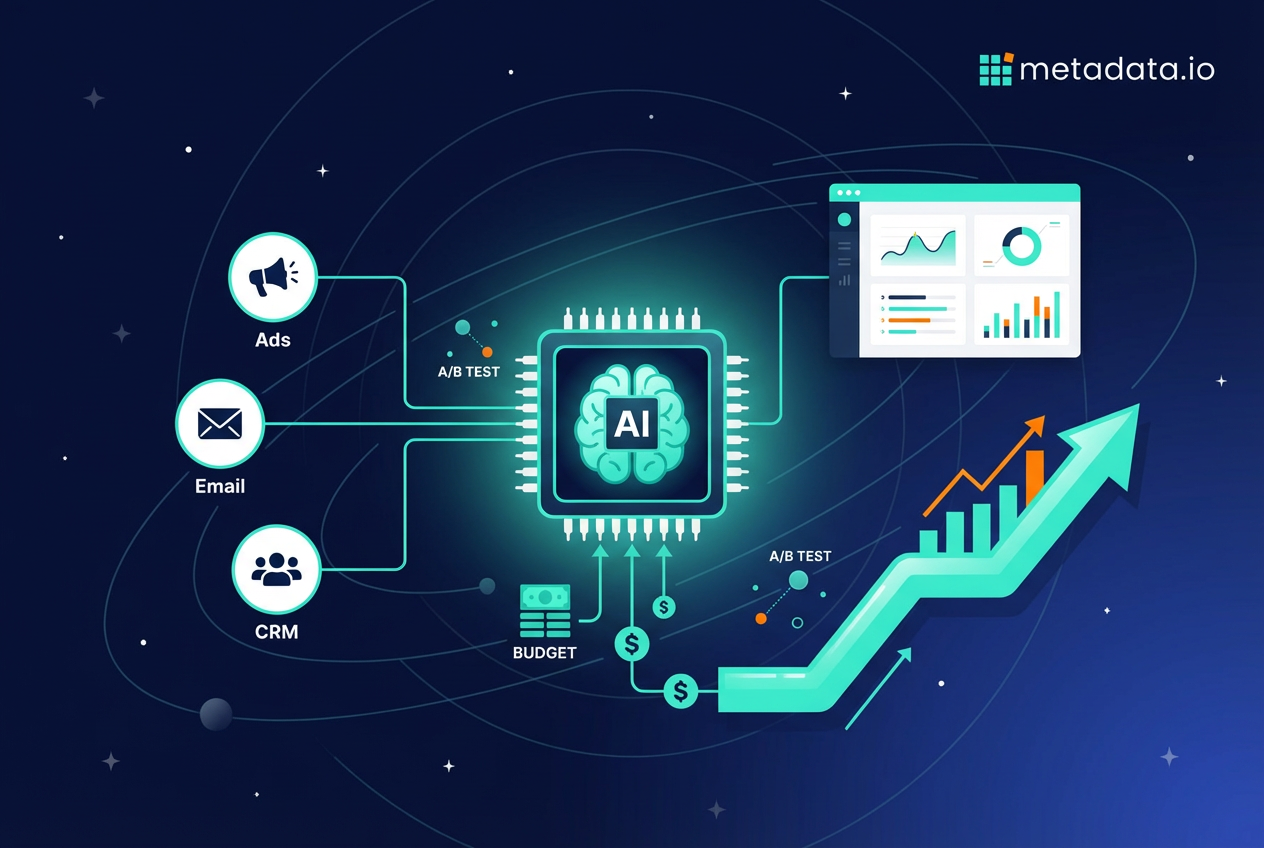
Real automation runs thousands of experiments at once. It tests different audiences, different creative, different copy, different bids—all at the same time across all your channels. Then it automatically moves budget to whatever’s working best.
You can’t compete with that manually. You’d need a team of 50 people working around the clock.
Stop celebrating lead volume. A “lead” is often just someone who downloaded a whitepaper. That’s not a buyer.
A qualified pipeline opportunity is an account that fits your ICP, is showing real intent, and is actually talking to sales. That’s what matters. Your automation should be built to generate pipeline, not leads. Because pipeline is what turns into revenue.
Most “automation” is just basic email workflows. If someone does X, send them email Y. That’s not really automation. That’s just a fancy to-do list.
AI is different. It doesn’t just follow rules you set. It learns, tests, and makes decisions on its own. And that’s where the real ROI comes from.
Traditional targeting is limited. You can target by job title, company size, maybe industry. That’s it.
AI can look at thousands of data points at once—your CRM data, intent signals, technographic data, behavioral patterns—and find the exact people who are most likely to buy from you right now. It builds audiences you didn’t even know existed.
This means you’re not wasting money on people who kind of fit your ICP. You’re spending money on people who are actively in-market and ready to buy.
Forget A/B testing. AI runs thousands of micro-experiments every single day. It tests which creative works for which persona. Which channel is best for which industry. What bid you need to win an impression at the lowest cost.
And it does this constantly. Every hour. Every day. Learning and improving with every dollar you spend.
A human marketer might test 10 things a month. AI tests 10,000 things a day. That’s the difference.
You check your campaign performance once a day. Maybe. AI checks it every minute.
If a LinkedIn campaign is suddenly generating high-value pipeline, AI can pull budget from an underperforming Google campaign and move it to LinkedIn. Instantly. Without you doing anything.
This means your money is always chasing the highest-return activities. Not the activities you set up three weeks ago and forgot about.
Not all automation delivers the same ROI. Some activities are way more valuable than others. Here are the ones that actually move the needle for B2B companies spending serious money on digital.
Manually building audiences in each ad platform is a waste of time. And it means your targeting is always out of date.
Automating this by syncing your CRM and intent data directly to your ad channels means your targeting is always current. You’re always reaching the right accounts. And you’re not wasting budget on people who don’t fit your ICP anymore.
This is the big one. Instead of a human tweaking bids and budgets, an automated system manages your entire paid strategy based on one goal: pipeline.
It works 24/7 to make sure your ad spend is turning into revenue as efficiently as possible. No manual work. No guessing. Just constant optimization toward the metric that actually matters.
In B2B, you sell to companies, not individuals. But most marketing tools treat every person as a separate lead.
Automation should instantly match incoming leads to their correct accounts in your CRM. This prevents duplicate records and gives your sales team the full picture of an account’s engagement before they pick up the phone.
Old-school lead scoring is static. A VP gets 10 points. A manager gets 5 points. Someone who visits your pricing page gets 3 points. It’s arbitrary and dumb.
Modern automation scores leads based on how closely they match your ICP and what they’re actually doing. A manager at a target account who’s viewing your pricing page three times a week is worth way more than a VP who downloaded one ebook six months ago.
Calculating marketing automation ROI isn’t just a finance exercise. It’s a forcing function that makes you focus on what actually matters: pipeline and revenue.
The old way of doing marketing—manual campaign management, weak targeting, celebrating MQLs—is a recipe for wasted budget and missed targets. The platforms that deliver real ROI in 2025 and beyond are the ones that automate the execution so you can focus on strategy.
They use AI to turn your ad spend into predictable pipeline. They give you the confidence that every dollar is working toward a real business result. Not just activity. Not just leads. Actual revenue.
If you’re tired of guessing whether your marketing is working, it’s time to try something different.
Frequently Asked Questions (FAQ)
What is a good ROI for marketing automation?
How long does it take to see ROI from marketing automation?
Can small businesses get a positive ROI from marketing automation?
Is marketing automation the same as a CRM?