Table of Contents
Most B2B marketers are tracking the wrong metric. Cost per opportunity tells you exactly how much you’re spending to create real pipeline—not just leads that go nowhere—and it’s the only number that actually connects your marketing budget to revenue.
Cost per opportunity (CPO) is the total amount you spend to generate one qualified sales opportunity. This means it measures how much money it takes to get a real, sales-accepted deal into your pipeline—not just a name in your database.
An “opportunity” is different from a lead. It’s a potential customer that your sales team has actually vetted, qualified, and moved into your CRM as an active deal. Think of it this way: a lead is someone who downloaded your ebook. An opportunity is someone your sales team is actively trying to close.
CPO connects your marketing spend directly to revenue potential. While other metrics tell you how many people clicked or converted, CPO tells you how much pipeline you’re actually creating for every dollar you spend.
If you just Googled “cost per opportunity,” you probably saw a bunch of articles about something called “opportunity cost.” That’s not what you’re looking for.
Opportunity cost is an economics term. It means the value of what you give up when you choose one thing over another. Like if you spend an hour in a meeting, the opportunity cost is the hour you could have spent doing literally anything else.
Cost per opportunity is a real marketing metric you can calculate and track. It lives in your spreadsheets and your CRM. It tells you exactly how much money you’re spending to create pipeline. Totally different things.
Calculating CPO is simple math, but you need two specific numbers first. The tricky part isn’t the formula—it’s making sure you and your sales team agree on what counts as an “opportunity” in your CRM.
This is every dollar you spent to generate opportunities during a specific time period. Most people pick a month or a quarter.
You need to include more than just ad spend:
Your budget across all paid channels like LinkedIn, Google, and Meta
The portion of marketing and sales salaries tied to these campaigns
Your tech stack costs for tools like your CRM, marketing automation, and analytics platforms
Any money spent creating content, ads, or creative assets
A lot of marketers only count ad spend. That gives you a fake number that makes your performance look better than it actually is.
This is how many new, sales-accepted opportunities you created during that same time period. Not leads. Not MQLs. Actual opportunities that sales agreed to work.
This number comes straight from your CRM. It’s usually a specific stage in your pipeline, like “Sales Qualified Opportunity” or “Stage 1 – Discovery.” Whatever you call it, make sure marketing and sales both agree on the definition before you start calculating anything.
Once you have both numbers, here’s the formula:
CPO = Total Marketing and Sales Spend / Total New Opportunities
That’s it. The result is a dollar amount that tells you how much you invested to create one real sales opportunity.
Let’s say you’re a B2B SaaS company and you just finished Q1. Here’s what your numbers look like:
You spent $75,000 on ads across LinkedIn and Google. Your team salaries and tech stack for the quarter added another $25,000. Your total spend is $100,000.
During Q1, your campaigns generated 50 new opportunities that sales accepted into the pipeline.
$100,000 / 50 = $2,000 CPO
Your cost per opportunity for the quarter was $2,000. Now you have a baseline. You can track whether that number goes up or down next quarter, and you can start making decisions about where to spend your budget based on which channels or campaigns have the lowest CPO.
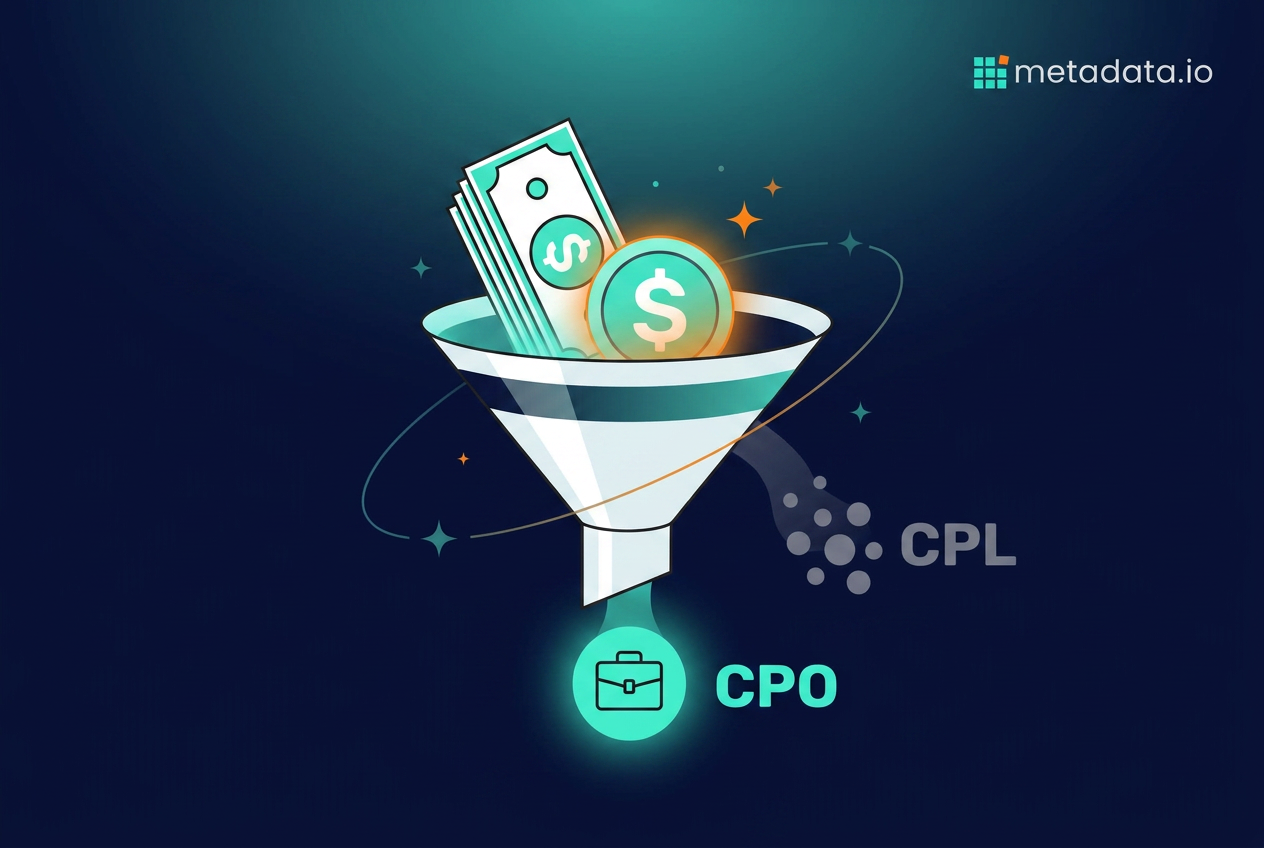
Most B2B marketers are obsessed with cost per lead (CPL). It’s easy to measure, and it feels good to report a low number to your boss. But CPL is a vanity metric that doesn’t tell you anything about revenue—especially when less than 1% of B2B leads actually convert to closed-won deals.
Here’s the problem: leads are cheap. Pipeline is not.
A low CPL usually means you’re generating a ton of unqualified leads from gated content or broad targeting. Those leads fill up your database, waste your sales team’s time, and never turn into customers. Your CPL looks great on a dashboard, but your pipeline stays empty.
|
Metric |
What It Measures |
What It Actually Tells You |
|---|---|---|
|
Cost Per Lead (CPL) |
The cost to get one contact (like an email address) |
How efficiently you’re generating top-of-funnel interest |
|
Cost Per Opportunity (CPO) |
The cost to create one sales-accepted opportunity |
How efficiently you’re generating qualified pipeline |
CPO forces you to measure what actually matters: qualified pipeline. It aligns marketing and sales around the same goal. And it changes the conversation with your CFO from “how many leads did you get” to “how much pipeline did you create for every dollar spent.”
If you’re still optimizing for CPL, you’re optimizing for the wrong thing.
There’s no universal “good” CPO. It depends entirely on your business model and how much money you make from each customer.
The biggest factor is your Annual Contract Value (ACV). If your ACV is $100,000, a $5,000 CPO is fantastic. If your ACV is $5,000, a $5,000 CPO means you’re losing money on every deal.
Other factors that affect what’s “good” for you:
Sales cycle length: Longer sales cycles usually mean higher CPO because you’re investing more time and money to nurture each account—and 74% of B2B marketers report that sales cycles are getting longer.
Industry competition: Competitive markets have higher ad costs, which drives up CPO.
Deal complexity: Enterprise deals with multiple stakeholders cost more to close than simple, transactional sales.
A rough benchmark is that a healthy CPO is usually 10-30% of your ACV. But the most important thing isn’t comparing yourself to other companies. It’s tracking your own CPO over time and working to improve it quarter over quarter.
Knowing your CPO is step one. Lowering it is how you prove your budget is working. This isn’t about finding cheap tricks. It’s about being smarter with your money and your time.
Your ideal customers aren’t defined by a vague persona doc someone wrote three years ago. They’re defined by real data: the technology they use, the size of their company, the problems they’re actively trying to solve right now.
Most ad platforms let you target by job title or industry. That’s not specific enough. You end up wasting money on people who look like your customer but will never buy.
To lower your CPO, you need to build audiences using firmographic data (company size, revenue), technographic data (what tech stack they use), and intent data (are they actively researching solutions like yours). This is why platforms like Metadata exist—to unify all that data so you can reach the exact people who are ready to buy, not just people who match a demographic profile.
The more precise your targeting, the less money you waste on people who will never convert.
Think about how much time you spend each week manually adjusting bids, reallocating budgets, and pausing underperforming ads. That’s low-value work that keeps you stuck in spreadsheets instead of thinking about strategy.
Here’s the thing: a machine can do that work better and faster than you can. AI agents can monitor performance 24/7, shift budgets to winning campaigns in real time, and pause ads that aren’t working—all based on actual pipeline data, not just clicks or impressions.
Automation doesn’t replace you. It frees you up to focus on the stuff that actually matters, like messaging, creative strategy, and figuring out which markets to go after next. It’s about moving from spreadsheets to strategy.
Traditional A/B testing is painfully slow. You test two headlines or three images over a few weeks, pick a winner, and move on. But what if the real winning combination is a specific headline, with a specific image, shown to a specific audience segment at a specific time of day? You’d never find it.
To lower your CPO, you need to test at scale. That means running thousands of variations of creative, copy, targeting, and timing to figure out what actually resonates with your audience. The faster you find what works, the faster you can cut what doesn’t and put more money behind the winners.
Most marketers don’t do this because it’s impossible to manage manually. But if you’re using a platform that can automate experimentation, you can find insights in days that would take months with traditional testing.
You can’t lower your CPO if you don’t know which campaigns are actually generating opportunities. Relying on UTM parameters and last-click attribution from ad platforms gives you an incomplete picture at best and a totally wrong picture at worst.
The only way to optimize for CPO is to have a direct connection between your ad platforms and your CRM. This lets you see exactly which ad someone clicked before they became an opportunity and eventually a customer.
Here’s what you need to track:
Which channel the opportunity came from (LinkedIn, Google, etc.)
Which campaign they engaged with
Which specific ad they clicked
How much you spent to generate that opportunity
Without this closed-loop tracking, you’re guessing. And guessing means you’re probably wasting money on channels and campaigns that don’t actually work.
Focusing on cost per opportunity isn’t just about tracking a new number. It’s a mindset shift.
It’s about moving from generating busywork for your sales team to generating real revenue for your company.
When you optimize for CPO, you force alignment between marketing and sales—and aligned teams are 80% more likely to hit their pipeline goals compared to just 50% for misaligned teams. You bring clarity to budget conversations with your CFO. And you focus your entire team on the one goal that actually matters: efficient growth.
Most marketers spend their time defending their budget and explaining why they need more money. When you track CPO, you can prove exactly how much pipeline you’re creating for every dollar you spend. That’s the conversation you want to be having.
It’s time to stop obsessing over clicks, impressions, and lead volume. Those metrics don’t pay the bills. Pipeline does. Focus on CPO, and you might actually start enjoying your job again.
Frequently Asked Questions (FAQ)
What is the difference between an SQO and an MQL?
How do I get sales and marketing to agree on an opportunity definition?
Can I track cost per opportunity in my CRM?
What other metrics should I track with CPO?