
Table of Contents
Most B2B marketers track way too many numbers and not enough of the ones that actually matter. This guide breaks down which metrics connect your ad spend to closed revenue, which ones just make you look busy, and how to set up measurement that proves your marketing makes money instead of spending it.
B2B marketing metrics are numbers that tell you if your marketing is making money or wasting it. They’re how you prove your campaigns are worth the budget, show your boss you’re not just burning cash, and figure out where to spend next quarter.
Here’s the thing though. Most marketers track way too many numbers or track the wrong ones entirely. Ad platforms love showing you clicks and impressions because those numbers always look good. But your CFO doesn’t care about clicks. They care about revenue.
The metrics that actually matter are the ones that connect your ad spend to closed deals. Everything else is just noise that makes you feel busy while your budget disappears.
Let’s start with the metrics you should mostly ignore. These look impressive in a slide deck but tell you almost nothing about whether your marketing is working.
Impressions are how many times your ad showed up on someone’s screen. That’s it. Just eyeballs on an ad.
A million impressions sounds amazing until you realize they were all shown to college students researching a paper, not your actual buyers. It’s like putting a billboard in the desert—lots of visibility, zero customers.
CTR is the percentage of people who saw your ad and clicked it. A high CTR means your ad copy is compelling enough to get attention.
But here’s the problem. A great CTR with terrible conversion just means you’re really good at false advertising. You’re getting people excited enough to click, then disappointing them when they land on your page. It measures ad quality, not business results.
This is the total number of people visiting your site. More traffic feels good, but it’s meaningless without context.
Ask yourself: are these visitors from companies you actually want to sell to? Are they looking at your pricing page or just bouncing after five seconds? Traffic from the wrong people is worse than no traffic at all because you’re paying for it.
Now we’re getting somewhere. These metrics move past vanity and start measuring your ability to generate actual potential customers.
An MQL is someone marketing thinks might become a customer based on who they are and what they’ve done. This usually means they fit your ideal customer profile and took some action like downloading content or attending a webinar.
MQLs are where marketing typically hands leads to sales. But this is also where things fall apart. Marketing celebrates hitting their MQL target while sales complains the leads are garbage. That’s why you can’t stop measuring here.
An SQL is a lead that sales has actually looked at and said “yes, this is worth pursuing.” They’ve confirmed there’s a real opportunity, not just someone who downloaded an ebook.
The conversion rate from MQL to SQL tells you if marketing and sales agree on what a good lead looks like. A low rate means you’re either targeting the wrong people or your MQL definition is way too loose.
This is the percentage of leads that become paying customers. It shows you the health of your entire funnel from first touch to signed contract.
High lead volume with a terrible conversion rate means something’s broken in the middle. Maybe your leads are low quality, maybe sales is slow to follow up, or maybe your messaging doesn’t match what you’re actually selling.
These are the only metrics your CEO actually cares about. When you can confidently report these numbers, you’ll never have to justify your budget again.
CAC is what it costs you to get one new customer. You add up all your sales and marketing spend for a period—salaries, software, ads, everything—and divide by the number of customers you closed.
This is the ultimate accountability number. It tells you exactly what you’re paying to buy a customer. Getting this right means connecting ad spend from every platform to closed deals in your CRM, which is a nightmare to do manually.
LTV is the total revenue you’ll make from one customer over their entire relationship with you. It’s a prediction of what each customer is worth.
LTV is the other side of the CAC equation. It tells you how much you can afford to spend to acquire a customer. A healthy B2B business usually has an LTV to CAC ratio of 3:1 or better.
Here’s what different ratios mean for your business:
Marketing ROI is the revenue you generate for every dollar you spend. The basic formula is revenue from marketing minus marketing spend, divided by marketing spend.
This number proves your team makes money instead of spending it. Positive ROI means you’re a revenue driver. Negative ROI means you’re a cost center. It really is that simple.
This is the total dollar value of all sales opportunities in your pipeline that came from marketing campaigns. It’s a preview of future revenue and shows marketing’s direct impact on sales.
Pipeline is faster feedback than closed revenue. It tells you if your campaigns are generating interest from the right accounts weeks or months before those deals actually close.
Knowing what to track is one thing. Actually tracking it is another. Here’s how to get your measurement working without drowning in spreadsheets.
You can’t measure success if you don’t know what success looks like. Before you spend anything, get specific about who you’re targeting.
Write down their job titles, industries, company sizes, and technologies they use. The more specific you get, the easier it becomes to measure if you’re reaching the right people.
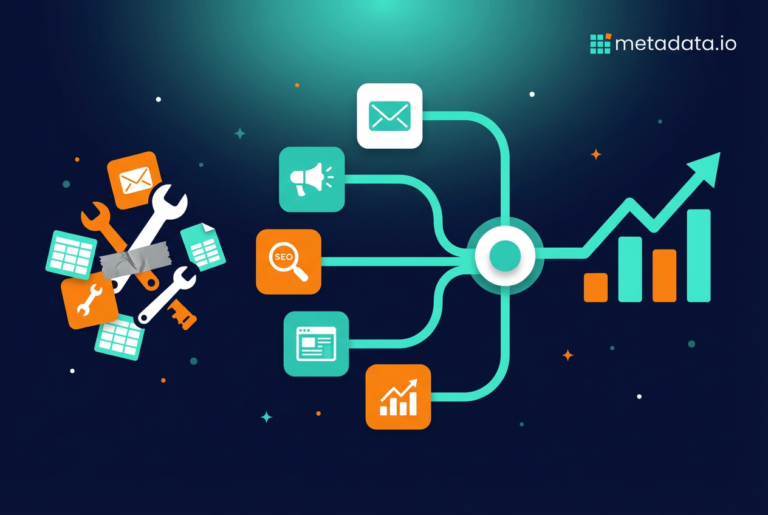
This is where most marketers get stuck. To measure revenue metrics, you need data from your ad platforms, your marketing automation tool, and your CRM all talking to each other.
Most teams do this manually with CSV exports and spreadsheets. It’s soul-crushing work that keeps you from doing actual marketing. The smarter move is finding a way to automate these connections so you can focus on strategy instead of data entry.
Don’t try to track everything at once. Pick one or two metrics that align with your main business goal.
If your goal is revenue growth, your primary metric should be pipeline or ROI, not MQLs. Everything else becomes a secondary indicator that influences your main number.
The goal is real-time visibility into which campaigns generate pipeline and which waste money. This lets you make decisions based on revenue instead of guesswork.
You could build this yourself with data engineers and months of work. Or you could use a platform that does it automatically so you can spend your time on marketing instead of building dashboards.
Making revenue is good. Making it efficiently is better. These metrics show you if you’re getting the most from every dollar.
This is pipeline generated divided by the ad spend that created it. If you spent $10,000 and generated $100,000 in pipeline, your ratio is 10x.
This helps you compare channels. One channel might have a lower cost per lead but only generate a 2x pipeline ratio. Another channel costs more per lead but delivers a 10x ratio. Now you know where to put more budget.
This is how long it takes for a lead to become a customer on average. Shorter cycles mean revenue comes in faster.
Marketing directly impacts this. Campaigns targeting high-intent buyers already looking for solutions naturally close faster than broad awareness campaigns. Tracking cycle length tells you about the quality and intent of your leads.
You didn’t become a marketer to live in spreadsheets. You got into this to understand customers, create compelling campaigns, and drive business results.
But too many marketers spend their days buried in manual reporting. They’re copying data between platforms, building pivot tables, and trying to piece together a story from a dozen disconnected sources.
The point isn’t building the world’s most complicated dashboard. It’s getting a clear signal on what works so you can do more of it and what doesn’t so you can stop wasting money.
Here’s the truth: marketing teams at companies spending serious money on ads don’t have full-time analysts just to track performance. They use platforms that automate both execution and measurement. This frees them up to be strategic marketers instead of data janitors.
The best marketing teams let technology handle the tedious work so they can focus on the thinking. They spend their time on strategy, creative, and customer insights—not VLOOKUPs and data exports.
When you automate the measurement and optimization of your campaigns, you stop reacting to last week’s data and start making decisions in real time. You see which campaigns drive pipeline the moment they start performing. You reallocate budget to what’s working before you waste another dollar on what’s not.
That’s the difference between tracking metrics and generating revenue. One keeps you busy. The other makes you money.
Frequently Asked Questions (FAQ)
What is the difference between a metric and a KPI?
How often should you report on B2B marketing metrics?
What are some good B2B marketing ROI benchmarks?
How do you measure brand awareness in B2B?