Table of Contents
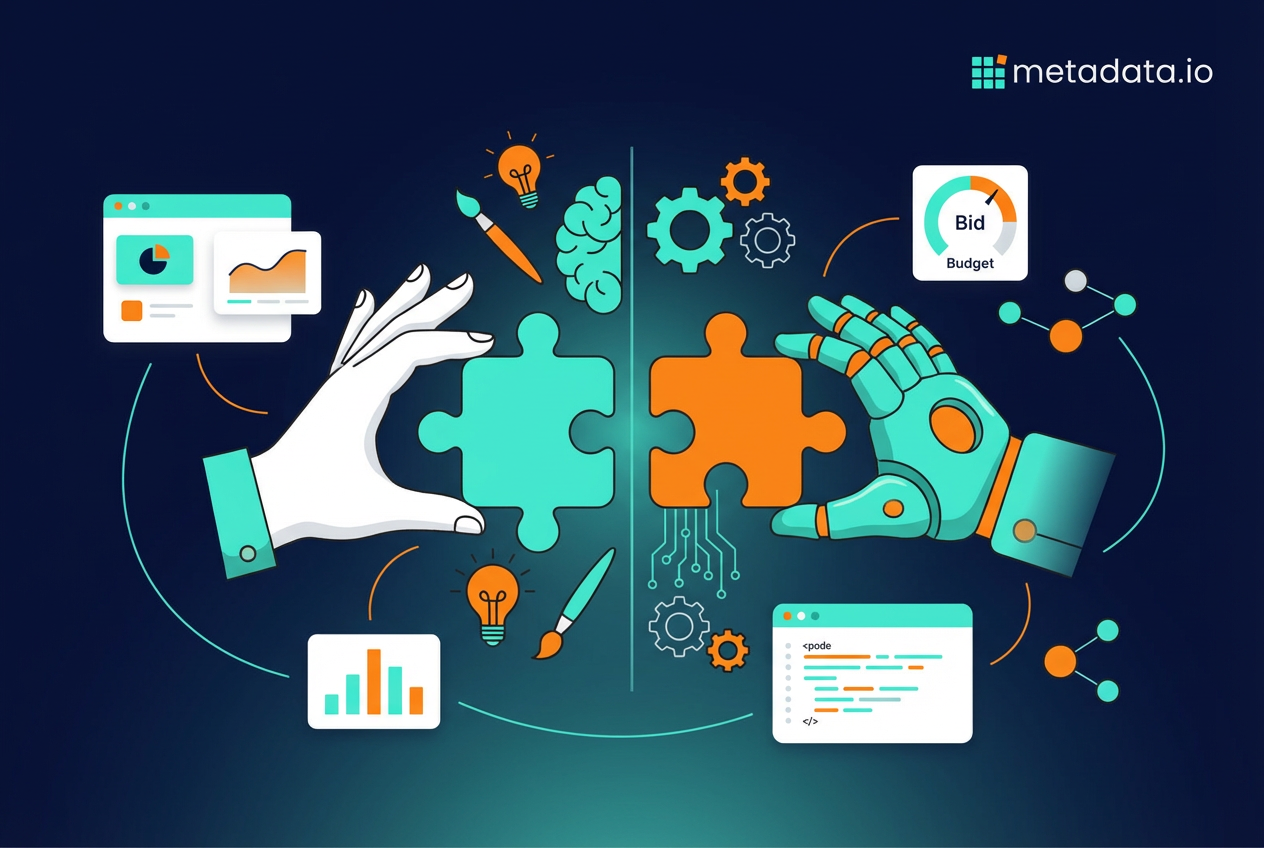
The whole AI vs. human debate in marketing is pointless because it’s not a competition, it’s a partnership. This article breaks down what AI actually does better than you, where you’re still irreplaceable, and how to combine both so you stop wasting time on grunt work and start focusing on strategy that actually drives revenue.
AI is software that can process massive amounts of data, spot patterns, and execute tasks at a scale no human ever could. This means it can analyze 10,000 ad variations in seconds and tell you which ones got the most clicks.
Human intelligence is your ability to understand context, read emotions, and figure out the ‘why’ behind what’s happening. This means you can look at that winning ad and explain why the message resonates with your audience’s current fears or desires.
Here’s the thing: one isn’t better than the other. They’re just different. AI is like having a calculator that can crunch numbers faster than you ever could. But you’re the mathematician who knows which problem needs solving in the first place.
The difference shows up in how each one works:
| What You’re Comparing | Artificial Intelligence | Human Intelligence |
|---|---|---|
| Speed and scale | Processes billions of data points in seconds and never needs a break | Limited by how fast you can think and how many hours you can work before burning out |
| Pattern recognition | Finds patterns in data that are invisible to the human eye | Can spot patterns but also gets distracted by bias and past experiences |
| Creativity | Generates variations based on what already exists but can’t invent something truly new | Creates original ideas, thinks strategically, and makes something from nothing |
| Reading people | Has zero ability to understand sarcasm, tone, or how someone is feeling | Excels at empathy, relationship building, and picking up on social cues |
| Handling the unexpected | Only adapts within the rules it was programmed to follow | Can figure out brand new situations using intuition and abstract thinking |
Let’s be real. Most marketing work is a grind. It’s repetitive, boring, and keeps you stuck in spreadsheets when you should be thinking about strategy.
This is exactly where AI should take over. It’s not about replacing you—it’s about getting rid of the work you hate anyway.
You can’t test every combination of ad creative, copy, audience, and channel by yourself. You’d need a team of 50 people and years to pull it off. Most marketing teams launch maybe 10 campaign experiments a month and call it progress.
AI can launch thousands. It tests every variable, learns from what works in real time, and automatically moves budget to the combinations that actually generate pipeline. It does the work of an entire performance team while you’re asleep.
Your best customers aren’t just hanging out on LinkedIn. They’re scrolling Facebook, reading Reddit threads, and watching YouTube videos. But the targeting on those platforms is built for B2C, not B2B. You end up showing your enterprise software ads to college students and retirees.
AI fixes this by connecting to your CRM and intent data to build audiences based on your actual customer profiles. Then it finds those exact people across every channel—giving you the same precision targeting you get on LinkedIn, but on platforms like Meta where your competitors aren’t even trying.
Think about how much time you spend babysitting campaign budgets. Checking if you’re overspending, watching your cost per lead creep up, manually shifting money between campaigns. It’s tedious and never-ending.
AI handles this automatically, 24/7. It watches performance against your actual goals—like pipeline generated or customer acquisition cost—and adjusts bids and budgets in real time. If a campaign tanks, it cuts the budget. If another one takes off, it gives it more fuel.
Attribution is a nightmare. Connecting ad spend to actual revenue feels like detective work. You’re pulling reports from LinkedIn, Google, Facebook, and your CRM, then trying to stitch them together in a spreadsheet that makes sense.
AI does this instantly. It connects directly to your ad platforms and CRM, tying every dollar spent to its impact on pipeline and revenue. You get a clear picture of what’s working without ever opening a spreadsheet.
AI is powerful, but it’s still just a tool. It doesn’t have instincts, can’t read a room, and has no clue what your brand actually stands for.
For anything that requires strategy, creativity, or a human touch, you’re still the most important part of the equation.
AI can tell you which campaigns performed best last quarter. But it can’t tell you that your main competitor just got acquired, or that new regulations are about to shake up your industry. It doesn’t know about the inside joke from last year’s conference or the subtle shift in how customers are talking about your category on social media.
That’s your job. You understand the market’s pulse, the competitive landscape, and the cultural context that shapes buyer behavior. You take those real-world insights and use them to guide what the AI should do next.
No one has ever built a real relationship with a machine. Your biggest customers want to talk to a person. They want to know you understand their problems and that you’re a partner they can trust, not just a vendor.
AI can’t hop on a call to save a struggling account. It can’t take a key prospect out for coffee or read between the lines when someone says “we’re still evaluating options.” The human connection is the foundation of B2B sales and marketing, and it always will be.
Ask AI to write your mission statement and you’ll get a generic paragraph full of corporate buzzwords. AI has no soul. It can’t define what your company stands for, what makes you different, or the story you want to tell.
That comes from you. You decide who you want to serve, what you believe, and what you want to be known for. This strategic work is the foundation of everything else, and it requires human creativity, passion, and vision.
AI can give you thousands of data points and recommendations. It can tell you Campaign A is outperforming Campaign B by 23%. But it can’t make the final decision.
You’re the one in charge of your marketing strategy. You take the AI’s analysis, add your market knowledge and business goals, and make the tough calls. You decide whether to double down, pivot, or kill something entirely. AI provides the intelligence. You provide the judgment.
This is the wrong question. It’s like asking if a forklift is stronger than a person. Yeah, it is, but someone still has to drive it.
AI is faster and more logical within a specific set of rules. It can process information at a scale that’s impossible for the human brain. But it has no common sense, no creativity, and no self-awareness. It can’t think outside the box because it doesn’t even know there’s a box.
Human intelligence is slower and messier. You make mistakes, get tired, and let emotions cloud your judgment sometimes. But you’re also flexible, intuitive, and can operate in situations where there are no clear rules. You can invent entirely new ways of doing things. AI can only get better at what it’s already been told to do.
So no, AI isn’t “smarter.” It’s just a different kind of intelligence. And the magic happens when you combine both.
The debate shouldn’t be AI vs. human expertise. It should be about finding the right partnership between the two.
When you get this balance right, you don’t just get better results. You get your time back and actually start enjoying your job again.
Start by looking at where your team wastes the most time. What tasks are manual, boring, and repetitive. That’s where AI should take over first.
Hand off tasks like:
This isn’t about eliminating jobs. It’s about eliminating the worst parts of those jobs so your team can focus on work that actually matters.
With all that time freed up, your team can now focus on high-impact work that requires a human brain. This is the stuff that moves the needle and can’t be automated.
Focus your energy on:
This isn’t a one-time setup. The relationship between you and AI should be an ongoing conversation. You set the strategy, AI executes and gathers data, then you analyze that data to refine the strategy.
Here’s what this looks like in practice. Your sales team tells you prospects keep asking about a specific feature. You take that insight and create new ad campaigns highlighting that feature. AI tests those campaigns across channels, tells you which message resonates most, and you use that feedback to update your sales deck. It’s a cycle where both human and machine make each other better.
The whole “man vs. machine” thing is a distraction. It’s not a competition. For B2B marketers, it’s the most powerful partnership you’ll ever have.
AI handles the scale, speed, and number-crunching that no human team could manage. You handle the strategy, creativity, and relationships that AI will never understand. When you combine them, you get a marketing operation that’s both ruthlessly efficient and genuinely intelligent.
The marketers who figure this out first are the ones who’ll win. They’ll stop wasting time in spreadsheets and start focusing on strategic work that drives real business impact. They’ll finally have the tools to prove their value and generate revenue as efficiently as possible.
And they might just fall in love with marketing again.
Frequently Asked Questions (FAQ)
Will AI surpass human intelligence in marketing?
Can AI replace human marketers completely?
What are the main characteristics of AI that make it useful for marketing?
How do you know when to use AI versus human expertise in your marketing?
What's the difference between AI and human intelligence in decision-making?
Can AI understand customer emotions and intent?