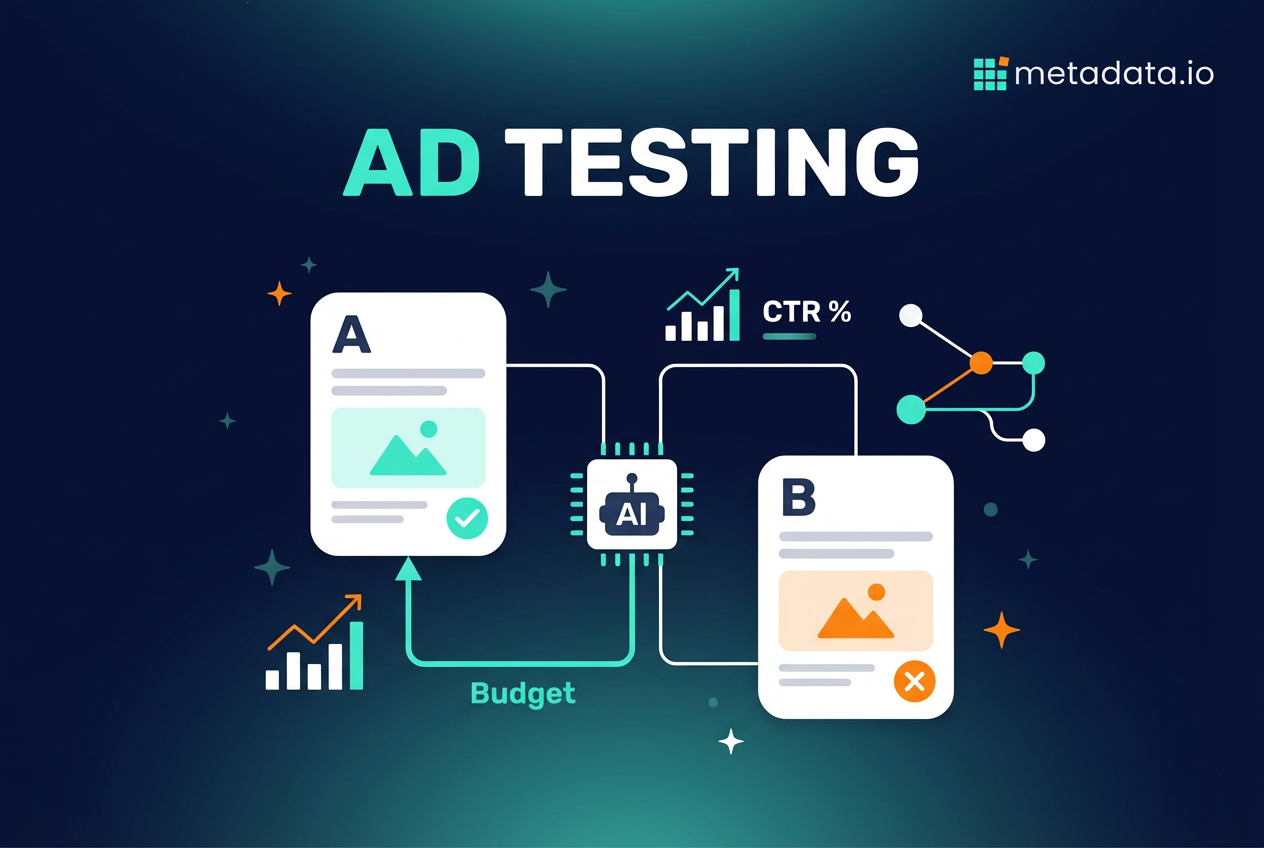
Most B2B marketers run ads, cross their fingers, and hope something works. This guide walks you through how to actually test your ads—what to test, how to test it, and why automation beats the manual spreadsheet nightmare that’s eating up your time right now.
What is ad testing anyway?
Ad testing is showing different versions of your ad to real people to see which one performs better. This means you stop guessing what works and start knowing what actually gets results.
Here’s how it works. You create two or three versions of the same ad—maybe you change the headline, swap out an image, or try a different call to action. Then you run them all at the same time to the same audience. After a few days or weeks, you look at the data to see which version got you closer to your goal.
The winner becomes your new baseline. Then you test something else against it. It’s a continuous loop of testing, learning, and improving. Instead of launching a campaign and crossing your fingers, you’re actively finding what makes your audience click, convert, and buy.
Why you should care about ad testing (especially in B2B)
You should care about ad testing because you care about not wasting money. Every dollar you spend on an ad that doesn’t work is a dollar you could have spent on one that actually generates pipeline.
In B2B, the stakes are higher than in consumer marketing. You’re not selling a cheap impulse buy. You’re dealing with long sales cycles, multiple decision-makers, and deals worth thousands or millions of dollars. A bad ad doesn’t just get ignored—it can make your brand look like it doesn’t understand the buyer at all.
Testing your ads directly impacts the numbers your boss and the CFO actually care about:
- Lower customer acquisition cost: When you find more effective ads, you get more results from the same budget. Each new customer costs less to acquire.
- Better quality pipeline: Testing helps you find messaging that resonates with your ideal buyers. This attracts leads who are actually a good fit, not just random form fills.
- Shorter sales cycles: When your ads speak to real pain points, buyers enter your funnel already understanding your value. They move faster from lead to customer.
Common advertising testing methods
There are a few main ways to test your ads. You don’t need to be a data scientist to understand them. But knowing the difference helps you pick the right method for what you’re trying to learn.
1. A/B testing
A/B testing is the simplest method. You compare two versions of an ad—Version A versus Version B—to see which performs better. The key rule is to change only one thing at a time.
For example, you might test two different headlines while keeping everything else identical. Or you test two images with the same copy. This way, you know exactly what caused the difference in performance.
A/B testing is perfect when you want a clear answer about a specific element. Does “Book a demo” work better than “Get started”? Does a product screenshot beat a customer photo? Run an A/B test and you’ll know.
2. Multivariate testing
Multivariate testing is A/B testing times ten. Instead of changing one element, you test multiple elements at the same time to find the best combination. You might test two headlines, three images, and two calls to action all at once.
The ad platform creates every possible combination and shows them to your audience. Then it tells you which combo wins. In this example, that’s 2 x 3 x 2 = 12 different ad variations running simultaneously.
The upside? You learn how different elements work together. Maybe headline A works best with image B, but not with image C. The downside? You need a lot more traffic to get reliable results. And managing it manually is basically impossible, which is why most people use an ad testing platform for this.
3. Ad concept testing
Ad concept testing happens before you build the actual ad. It’s when you test the core idea or message of a campaign with your target audience before you invest in creative production.
You might show people a few different concepts through surveys or interviews. For example, you could test whether a message about “saving time” is more compelling than one about “reducing costs.” This helps you avoid spending thousands on creative for a concept that falls flat.
What ad elements should you actually test
You can test almost anything in an ad. But some elements have a bigger impact on performance than others. Focus on these first.
Ad creative testing
Your creative is the visual part of your ad. It’s what stops someone from scrolling past. This makes it one of the most important things to test.
Here’s what to experiment with:
- Images versus videos
- Product screenshots versus photos of people
- Bold, high-contrast designs versus subtle, branded ones
- Different layouts and text placements
Sometimes a simple change—like switching from a generic stock photo to a real screenshot of your product—can double your click-through rate.
Copy
The words in your ad do the convincing. Your headline and body copy need to make someone want to take the next step. Small tweaks here can lead to big differences.
Test different approaches to your headline. Try a question (“Tired of manual campaign management?”), a benefit statement (“Run better ads in half the time”), or a bold claim (“Most B2B ads waste 60% of their budget”). See which one resonates.
Also test the length and tone of your body copy. Sometimes short and punchy wins. Other times, your audience wants more detail before they’ll click.
Call to action (CTA)
Your CTA tells people exactly what to do next. It’s one of the easiest elements to test and often has a huge impact on conversion rates.
Try different wording like “Book a demo,” “Request a demo,” or “See it in action.” Test different offers like “Download the guide” versus “Read the report.” Even test whether a button works better than a text link.
Audience
Who sees your ad matters just as much as what the ad says. Most marketers set their targeting once and never touch it again. But testing different audiences can uncover new groups of high-intent buyers.
Instead of relying on basic targeting like job titles and company size, test audiences built from richer signals:
- Firmographics: Company size, industry, revenue, location
- Technographics: The software and tools a company already uses
- Intent data: People actively researching solutions like yours right now
This is where you can get a real edge over competitors who are all targeting the same generic audiences.
How to run a successful campaign testing program
Running one test is good. Building a system for continuous testing is what separates amateurs from pros. Here’s how to do it right.
Step 1: Define your goal
Start with what you’re actually trying to achieve. Don’t just say “better performance.” Get specific. Are you trying to lower your cost per lead? Increase demo requests? Generate more pipeline?
Your goal determines which metric you’ll use to declare a winner. If you care about pipeline, don’t optimize for clicks. If you care about brand awareness, impressions might matter more than conversions.
Step 2: Form a hypothesis
A hypothesis is an educated guess about what will happen. It follows a simple format: “Changing [this thing] will cause [this result] because [this reason].”
For example: “Using a video ad instead of a static image will increase our click-through rate because video is more engaging and stops the scroll better.” This gives you a clear prediction to test against.
Step 3: Choose your variables and audience
Decide exactly what you’re testing and who you’re testing it on. Focus less on moving the CTA a pixel to the left or to the right, and instead focus on bigger concepts. If you’re doing an A/B test, pick one variable to change. If you’re doing multivariate testing, you can test a few things at once.
Make sure your audience is big enough to give you a clear answer. Testing on 100 people won’t tell you much. Testing on 10,000 will. You’re looking for statistical significance.
Step 4: Run the test
Set up your campaign variations in your ad platform. Split your budget evenly between the versions. Let the test run long enough to collect meaningful data—usually at least a week, sometimes longer depending on your traffic.
Don’t call it early just because one version is winning after day one. You need enough data to be confident the difference is real, not just random chance.
Step 5: Analyze the results
Once the test is done, look at your numbers. Did one version clearly beat the other on your primary goal? Was the difference big enough to matter?
Don’t just pick the version with slightly better numbers. Make sure the result is statistically significant. Most ad platforms will tell you this, or you can use a free calculator online.
Step 6: Apply the learnings and repeat
Take your winning ad and make it the new control. Use what you learned to form your next hypothesis. Then test again.
The goal isn’t to run one perfect test. It’s to build a machine that’s always testing, always learning, always getting better.
The problem with traditional ad testing tools
If that six-step process sounds exhausting, that’s because it is. Running a proper testing program manually is a ton of work. This is the part nobody talks about.
You’re stuck in spreadsheets trying to compare data from LinkedIn, Google, Meta, Reddit, and your CRM. You spend hours building dozens of campaign variations just to test a few headlines. You make decisions based on surface metrics like clicks because connecting ad spend to actual revenue is nearly impossible without a data analyst.
This manual approach is slow and doesn’t scale. You might squeeze in one or two simple A/B tests per month. But you’ll never have time to run the hundreds or thousands of experiments needed to really move the needle.
And here’s the worst part: by the time you finish analyzing one test and setting up the next one, the market has already changed. Your competitors have moved on. Your buyers are seeing different messages. You’re always playing catch-up.
How AI automates ad testing and drives revenue
The manual, spreadsheet-driven approach to ad testing is outdated. Today, AI and automation handle the grunt work so you can focus on strategy and creative thinking.
Imagine a system that runs thousands of experiments automatically, 24/7. It tests every combination of creative, copy, and audience without you touching a single campaign setting. It doesn’t just look at clicks—it connects to your CRM to see which ads generate qualified pipeline and revenue.
| Manual ad testing | Automated ad testing |
|---|---|
| Hours of manual setup | Campaigns built in minutes |
| Test 2-3 variations | Test thousands of variations |
| Optimize for clicks or leads | Optimize for pipeline and revenue |
| Data scattered across platforms | Unified view of performance |
| Weekly analysis and adjustments | Real-time, automatic optimization |
This is what a real ad testing platform does. It takes the entire six-step process and puts it on autopilot. It finds winning combinations and automatically moves budget to them in real time. It’s like having a team of analysts and ad ops specialists working around the clock.
The result? You stop wasting time on low-value tasks. You finally have data that proves the value of your marketing spend. You get a clear path to generating revenue more efficiently. You stop being a spreadsheet jockey and start being a marketer again.
When AI handles the testing, you get to do the work that actually matters—developing strategy, crafting compelling messages, and understanding your buyers. You know, the stuff you got into marketing to do in the first place.
Benchmark context: across 153 B2B advertisers and $57.6M of 2025 ad spend, Metadata's 2026 B2B Paid Media Benchmark reports what a LinkedIn lead actually cost, and how that varied by ad format, audience and offer type.