Table of Contents
Agentic GTM is when AI agents run your go-to-market strategy for you. You set the strategy and build the system, but agents actually do the work. This article breaks down what agentic AI really means, how it differs from the AI tools you’re using now, and how it can take the manual work off your plate so you can focus on strategy rather than spreadsheets.
Agentic GTM is when AI agents run your go-to-market strategy for you. These aren’t tools that give suggestions—they’re autonomous systems that take action to hit specific goals, like generating qualified pipeline or lowering your customer acquisition cost.
Here’s what that actually looks like. You give an AI agent a budget, your ideal customer profile, and a revenue target. The agent launches campaigns, tests creative, shifts budget between channels, and refines audiences on its own. No babysitting required.
This is different from the AI tools you’re probably using now. ChatGPT waits for you to ask it something. Your grammar checker waits for you to write. Agentic AI doesn’t wait. It has a goal and figures out how to achieve it without you stepping in every five minutes.
Think of it like this: a calculator solves any math problem you give it. An accountant actively manages your finances to grow your net worth. One responds. The other acts. That’s the difference between regular AI and agentic AI.
Most AI is passive. It reacts to what you tell it to do. You type a prompt, it gives you an answer. You upload a document, it summarizes it. The AI is always waiting on you.
Agentic AI is proactive. It doesn’t sit around waiting for instructions. You give it a goal—like “generate 50 qualified demos this month”—and it goes to work. It makes decisions based on real-time performance data, learns what’s working, and adjusts its approach without you needing to check in.
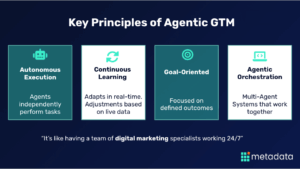
This is what separates agentic AI from basic automation. Automation follows a script. If this happens, do that. Agentic AI thinks. It evaluates options, tests hypotheses, and changes course when something isn’t working. It’s the difference between a robot arm on an assembly line and a team member who can solve problems on their own.
Let’s be real. Your B2B marketing setup is probably exhausting you. You spend hours, sometimes days, manually building campaigns in LinkedIn, Google, and Meta. You create audiences based on gut feelings and hope they’re right.
Then you’re stuck in spreadsheets trying to figure out which ad is working and which one is just lighting money on fire. You make a few tweaks, wait a week for enough data to come in, and do it all over again. It’s slow, it’s tedious, and it’s nearly impossible to scale.
This manual approach keeps you from doing the work that actually matters. Strategy. Messaging. Understanding what your customers really need. Instead, you’re drowning in tactical busywork that a machine could handle better anyway.
The worst part? You’re forced to choose between running a few campaigns well or running a lot of campaigns poorly. You can’t do both. Your ad budget is never working as hard as it should be because you physically can’t keep up with all the optimizations that need to happen.
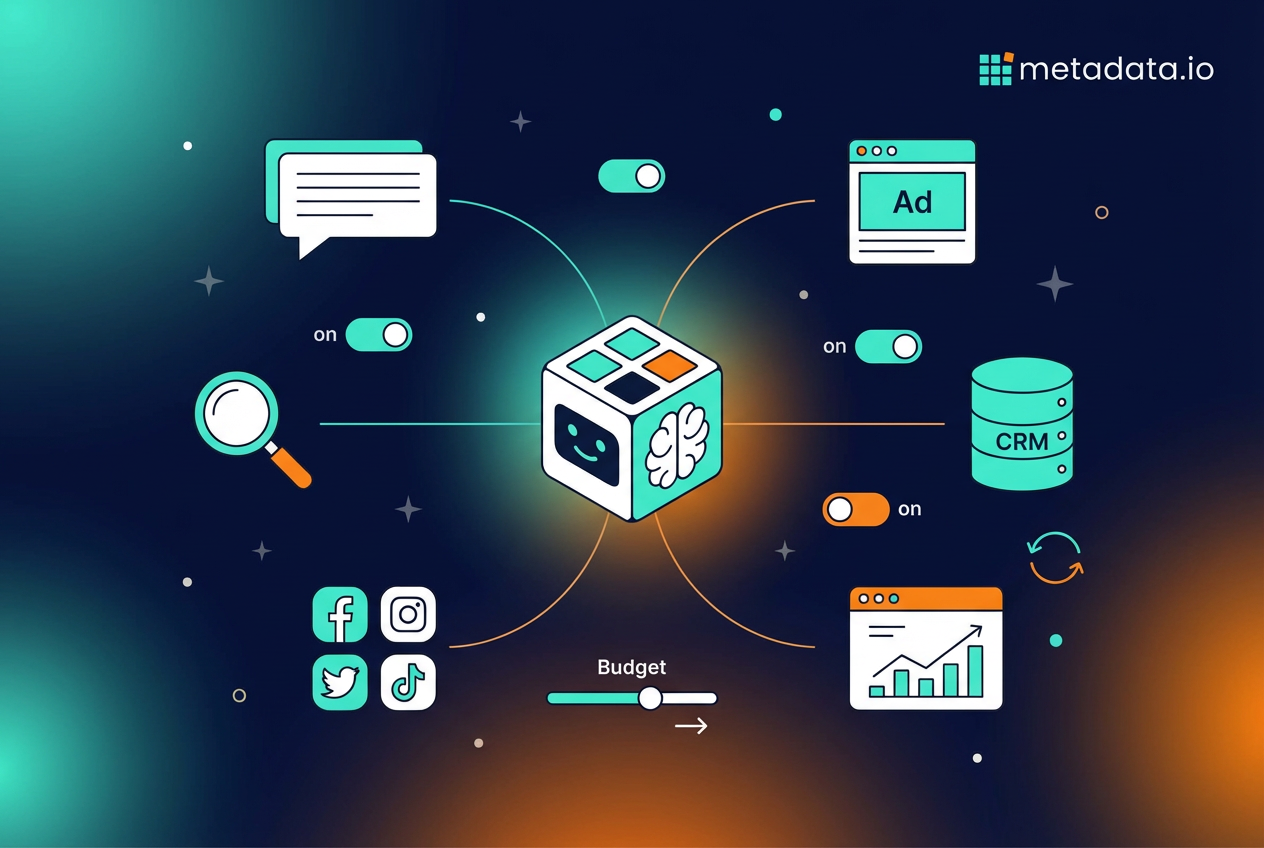
In B2B marketing, AI agents act like autonomous campaign managers. You set the strategy—who you’re targeting, what you want to achieve, how much you’re willing to spend—and the agents handle everything else. They connect to your ad platforms, your CRM, and your data sources to create a closed loop where they take action, measure results, and improve.
This isn’t about replacing you. It’s about giving you a team of tireless workers so you can focus on the strategic stuff only humans can do.
Instead of manually building campaigns in every ad platform, an AI agent does it for you. You give it the raw materials—creative assets, copy variations, landing pages—and it assembles and launches hundreds or thousands of campaign experiments across different channels.
It handles all the annoying setup work. Naming conventions. Tracking parameters. Making sure nothing gets missed. The kind of stuff that takes you hours but doesn’t actually require creative thinking.
Forget the limited targeting options inside ad platforms. An AI agent builds hyper-specific audiences by pulling data from multiple sources at once.
Here’s what that looks like in practice:
The agent combines all of this to create audiences you couldn’t build manually. Especially on platforms like Meta, where B2B targeting is usually a nightmare.
An AI agent watches your campaigns 24/7. Something no human can do. It analyzes which ads, audiences, and channels are actually driving qualified pipeline—not just cheap clicks or vanity metrics.
If an ad on LinkedIn is generating expensive, low-quality leads, the agent pauses it and moves that budget to a better-performing ad on Google. All in real time. Your ad spend is always being used as efficiently as possible to hit your revenue goals.
You know you should be testing more creative. But who has time? An AI agent tests every possible combination of your headlines, body copy, images, and calls to action. It runs these experiments at the same time, finds the winners for each audience segment, and automatically scales what works.
No more guessing. No more manual analysis of which ad performed better. The agent figures it out and acts on it.
Switching to an agentic GTM model isn’t just about saving time. It changes the results you get from your marketing budget. You move from guessing to knowing. From manual tasks to measurable impact.
Here’s what you can expect:
| Traditional GTM | Agentic GTM |
|---|---|
| Manual campaign setup | Autonomous campaign execution |
| Broad, platform-based audiences | Precise, multi-source audiences |
| Weekly or monthly budget shifts | Real-time budget optimization |
| A/B testing a few variations | Testing thousands of combinations |
| Optimizing for clicks and leads | Optimizing for pipeline and revenue |
| Marketers buried in tactical work | Marketers focused on strategy |
Let’s make this concrete. Here’s what agentic marketing looks like when you’re actually using it.
Say you’re launching a new product feature. In the old world, you’d spend days building campaigns manually. Writing ad copy. Designing creative. Setting up audiences in LinkedIn, Google, and Meta separately. Monitoring performance. Making adjustments.
With an agentic approach, you give the AI agent your product messaging, your target account list, and your budget. The agent builds 50 different ad variations, creates audiences across all three platforms using your CRM data and intent signals, and launches everything. Within hours, it’s already shifting budget away from underperforming ads and doubling down on what’s working.
Or take creative testing. You have three headlines, four images, and two calls to action. That’s 24 possible combinations. Testing all of them manually would take months. An AI agent tests all 24 at once, figures out which combinations work best for which audience segments, and scales the winners. All while you’re working on next quarter’s strategy.
Here’s another one. Your sales team tells you they’re getting too many unqualified leads from paid ads. An agentic system can automatically adjust audience targeting to focus on accounts that match your ideal customer profile more closely. It can also shift budget away from channels driving low-quality leads and toward channels driving demos that actually close. No manual intervention needed.
If you’re interested in seeing an example of an Agentic System working, check out MetadataONE.
Marketers are running their entire digital advertising programs inside their LLM.
Making the switch to an agentic approach is more about changing your mindset than rebuilding your entire marketing operation. It starts with letting go of the need to control every little detail and trusting the system to do its job.
First, define your goals clearly. An AI agent needs a North Star. Is your primary goal to generate marketing qualified accounts from a specific list? Or is it to get the lowest cost-per-demo from a broader audience? Be specific about what success looks like.
Next, connect your data. An agent is only as smart as the data it can access. This means integrating your CRM, your marketing automation platform, and your ad accounts. The goal is to give the agent a complete view of the customer journey, from first touch to closed deal.
Finally, start small and learn to trust the process. Pick one channel or one campaign to begin with. Let the agent run, learn, and optimize. Resist the urge to jump in and make manual changes every day. The whole point is to let the AI find patterns and opportunities you would have missed.
You’ll probably feel uncomfortable at first. That’s normal. You’re used to being in control of every decision. But once you see the results—lower costs, more pipeline, and hours of your time back—you’ll wonder why you didn’t do this sooner.
The biggest mistake people make with agentic marketing is not giving it enough time to learn. AI agents need data to get smarter. If you only run a campaign for three days and then shut it down because it’s not perfect, you’re not giving the system a chance to work.
Another mistake is setting vague goals. “Get more leads” isn’t specific enough. An agent needs to know what kind of leads, from which accounts, at what cost. The more specific you are, the better the agent can optimize.
Don’t try to control everything. If you’re constantly overriding the agent’s decisions because you “have a feeling” about something, you’re defeating the purpose. Let the data guide the decisions. Your job is to set the strategy, not micromanage the tactics.
And don’t expect it to replace your entire marketing team. Agentic AI handles execution and optimization. It doesn’t come up with your brand positioning. It doesn’t write your messaging strategy. It doesn’t build relationships with customers. Those are still your job.
The role of a B2B marketer is changing. It’s no longer about who can manage the most campaigns by hand or build the most complex spreadsheets. It’s about who can build the most efficient GTM engine.
An agentic approach gives you that efficiency. It takes the repetitive, low-value work off your plate so you can focus on the strategic challenges that actually require a human brain. You stop being a campaign manager and start being a revenue driver.
This is your chance to get ahead. Most marketing teams are still doing things the old way. They’re buried in manual work and wondering why they can’t hit their pipeline targets. You can be different.
You can build a marketing function that scales, learns, and delivers predictable results. You can spend your time on creative strategy instead of spreadsheet maintenance. You can actually enjoy marketing again.
That’s what agentic GTM is really about. Not just better results—though you’ll get those. It’s about reclaiming your time and your sanity so you can do the work you actually signed up for.
Frequently Asked Questions (FAQ)
What's the difference between marketing automation and agentic GTM?
How much does it cost to implement agentic marketing?
Can agentic AI work with my existing marketing stack?
How long does it take to see results from agentic marketing?
Do I need a data scientist to use agentic marketing?
What happens if the AI agent makes a mistake?
Is agentic marketing only for large enterprise companies?