Table of Contents
AI in B2B marketing isn’t about robots taking over your job—it’s about getting back the 60% of your week you waste on manual campaign work so you can actually do strategy. This guide breaks down what AI actually does in marketing, which tools solve real problems versus which ones are just hype, and how to use AI to hit your pipeline numbers without spending your life in spreadsheets.
AI in B2B marketing is software that automates the repetitive work eating up your day and makes smarter decisions based on your data. This means instead of you manually adjusting bids, building audiences, or analyzing spreadsheets for hours, the software does it for you—faster and more accurately than any human could.
Here’s what that looks like in practice. You’re running LinkedIn ads, Google campaigns, and maybe some Facebook tests. Normally, you’d log into each platform, check performance, move budget around, update targeting, and hope you made the right call. AI does all of that automatically. It watches your campaigns 24/7, sees what’s working, and shifts your budget to the winners in real time.
The technical term for how this works is machine learning. That’s just a fancy way of saying the software learns from your past campaign data—what got clicks, what generated leads, what actually closed deals—and uses those patterns to make better decisions going forward. The more data it sees, the smarter it gets.
But here’s the thing most people miss. AI in marketing isn’t one thing. It’s a bunch of different technologies doing different jobs. Some AI writes your ad copy. Some AI finds your target audience. Some AI manages your ad spend. They all get lumped under “AI,” but they work in completely different ways and solve completely different problems.
Look, you’ve heard a thousand “revolutionary” marketing trends that turned out to be nothing. So why is AI different?
Because it solves the actual problems keeping you from hitting your numbers. Not theoretical problems. The real ones you deal with every single day.
You get your time back. Most B2B marketers spend 60-70% of their week on manual campaign work—building audiences, writing ad copy, adjusting bids, pulling reports. AI handles that stuff automatically. That’s not an exaggeration. Platforms can now launch entire campaigns, test dozens of variations, and optimize performance without you touching a single button.
You stop lighting money on fire. Bad targeting is the number one reason ad budgets get wasted. You’re either too broad and pay for clicks from people who’ll never buy, or too narrow and miss your best prospects entirely. AI can analyze thousands of data points—job titles, company size, tech stack, buying signals—and find your exact ideal customer. Then it puts your ads in front of those people and nobody else.
You can actually prove your impact. The “marketing can’t measure ROI” excuse is dead. AI platforms connect directly to your CRM and track every dollar you spend all the way to closed deals. You can finally walk into a meeting and say “we spent $50K on ads last month and generated $500K in pipeline” with the receipts to back it up.
The bottom line? AI isn’t hype. It’s the difference between spending your days in spreadsheets and actually doing strategic work that moves the business forward.
Enough theory. Here’s how you actually use AI to get better results starting right now.
Running paid campaigns the old way is brutal. You launch something on LinkedIn. Wait three days for enough data. Export it to a spreadsheet. Stare at the numbers. Make your best guess about what to change. Repeat forever.
AI agents flip this entire process. An AI agent is software that can take actions on your behalf based on goals you set. So instead of you checking campaign performance and manually moving budget around, the agent does it automatically.
Here’s a real example. You’re running ads on Google and LinkedIn with a $30K monthly budget. Your goal is to generate qualified leads at under $200 each. You set that goal once. The AI agent then runs hundreds of experiments—testing different audiences, ad copy, bid strategies—and automatically moves money from what’s not working to what is. It does this every single day, all day long.
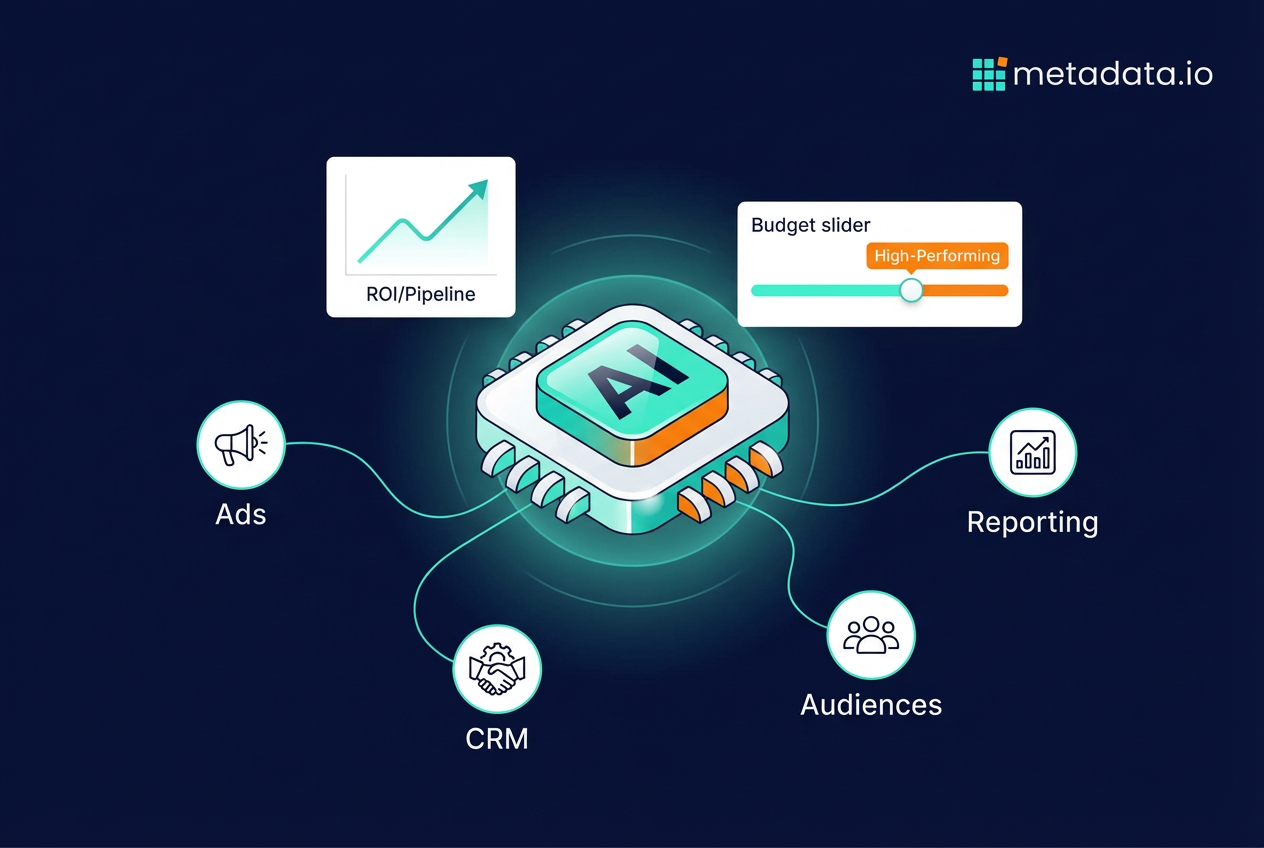
A platform like Metadata uses AI agents to manage your entire paid advertising operation. If your LinkedIn campaign is generating leads at $150 each and your Google campaign is at $300, the agent automatically shifts budget to LinkedIn. If a specific ad creative is crushing it, the agent increases its spend. You wake up to better results without doing any of the work.
Most ad platforms give you terrible targeting options. LinkedIn is decent for B2B, but everywhere else? Good luck. Facebook thinks “business owner” is a useful category. Google wants you to target keywords like you’re still living in 2010.
AI solves this by building custom audiences based on your actual customer data. It takes your CRM data—the companies and people who already bought from you—and finds more people just like them. Then it layers on firmographic data (company size, industry, revenue), technographic data (what software they use), and intent data (are they actively looking for a solution like yours right now).
The result is scary-accurate targeting. You can find mid-market SaaS companies in North America with 100-500 employees who use Salesforce and are currently researching marketing automation tools. Then you can target those exact people on Facebook, even though Facebook has no idea what “marketing automation” means.
This is how you get LinkedIn-level targeting on every channel. Your ads stop going to random people and start going to the exact buyers you want to reach.
Hitting your MQL target feels great until sales tells you the leads are garbage. This happens because most marketers optimize for volume instead of quality. You need 500 leads this quarter, so you cast a wide net and hope some of them are good.
AI flips this. Instead of optimizing for “leads,” you optimize for “leads that actually turn into customers.” The AI looks at which leads closed in the past, identifies what made them different, and focuses your ad spend on finding more people like that.
This is called predictive lead scoring. The AI scores every lead based on how likely they are to buy. A VP at a company that matches your ICP who downloaded three pieces of content and visited your pricing page? That’s a 95. A random person with a Gmail address who clicked an ad once? That’s a 12.
You can then set rules like “only send leads with a score above 70 to sales” or “automatically nurture leads below 50 until they’re ready.” Sales gets better leads. You get better conversion rates. Everyone’s happy.
Content creation is a grind. You need ad copy, email sequences, landing pages, blog posts, social media updates. The demand never stops, but your brain does.
Generative AI tools are built for this. These are the ChatGPTs and Jaspers of the world. You give them a prompt like “write five LinkedIn ad headlines for a webinar about AI in marketing” and they spit out options in seconds.
Here’s how to actually use them without the output sounding like a robot wrote it:
Generative AI won’t replace your creativity. But it will help you produce more content, faster, without burning out.
Here’s where people get confused. When someone says “AI in marketing,” they might mean the thing that writes your blog posts. Or they might mean the thing that manages your ad budget. Those are completely different.
Generative AI creates new stuff. It’s trained on millions of examples from the internet and can write copy, generate images, or even code. Think ChatGPT, Midjourney, or Jasper. Its job is to help you make things faster.
Execution AI runs your operations. It’s trained on your specific business data—your CRM, your ad performance, your website analytics. Its job isn’t to create something new. It’s to take the campaigns you already have and make them perform better by constantly testing and optimizing.
Here’s the difference in practice:
| Generative AI | Execution AI | |
|---|---|---|
| What it does | Creates content from scratch | Analyzes data and takes action |
| Example | “Write ad copy for my new ebook” | “Move budget from low-performing ads to high-performing ads” |
| Goal | Speed up content production | Hit your revenue and pipeline goals |
| What it needs | A good prompt | Access to your performance data |
You need both. Generative AI helps you create the assets. Execution AI makes sure those assets actually drive results. But if your goal is turning ad spend into revenue, execution AI is what matters most.
The market is flooded with “AI marketing tools.” Most of them slap “AI” on their homepage and call it a day. But there are a few categories worth paying attention to.
These platforms manage your entire paid advertising operation. They don’t just report on your campaigns—they actually run them. They build audiences, launch ads, test variations, adjust bids, and move budget around automatically based on your goals.
This is where platforms like Metadata live. The AI agents handle everything from campaign setup to optimization, so you can focus on strategy instead of execution. If you’re spending $50K+ per month on paid ads and want to stop babysitting campaigns, this is the category that matters.
ABM platforms help you focus on specific high-value accounts instead of casting a wide net. They use AI to identify which accounts are showing buying signals, then help you run coordinated campaigns to engage those accounts across multiple channels.
The big names here are 6sense, Demandbase, and Terminus. They’re great if you’re selling to enterprise companies with long sales cycles and need to get multiple stakeholders engaged before anyone will take a meeting.
This is the fastest-growing category. Tools like Jasper, Copy.ai, and ChatGPT help you write ad copy, emails, blog posts, and social media content faster. They’re not going to write your entire content strategy for you, but they’re excellent for breaking through writer’s block and creating variations to test.
The key is knowing what you’re trying to solve. If your problem is “I’m spending too much time managing campaigns,” you need an execution platform. If your problem is “I can’t write enough content,” you need a generative tool. Don’t buy a hammer when you need a screwdriver.
Here’s the truth nobody wants to say out loud. Most B2B marketing jobs have turned into button-pushing jobs.
You spend your Monday setting up campaigns. Tuesday pulling reports. Wednesday adjusting bids. Thursday building audiences. Friday writing performance recaps for your boss. You’re busy all week, but you’re not doing marketing. You’re doing operations.
AI changes this. When software handles the execution, you get to do the work you were actually hired for. You can think about positioning. Test big creative swings. Figure out which market segments to go after. Build a strategy that actually differentiates your company instead of just copying what your competitors are doing.
This isn’t about replacing marketers. It’s about replacing the boring parts of marketing so you can focus on the interesting parts. The parts that require creativity, intuition, and strategic thinking. The parts that actually move the business forward.
And here’s the best part. When AI is managing your campaigns and tracking everything back to revenue, you can finally prove your impact. No more “marketing is a black box” conversations with your CFO. You can show exactly how much pipeline and revenue your work generated. That’s how you go from being seen as a cost center to being seen as a growth driver.
The marketers who figure this out first are going to have a massive advantage. They’ll move faster, spend smarter, and deliver better results than everyone still doing things the old way. The question is whether you want to be one of them or get left behind.
Ready to stop pushing buttons and start driving revenue? Book a demo with Metadata.
Frequently Asked Questions (FAQ)
How much technical skill do I need to use AI marketing tools?
Will AI replace my marketing job?
How do I measure the ROI of an AI marketing platform?
Can small B2B companies use AI or is it just for enterprises?