
Table of Contents
Pipeline marketing is how you stop counting leads and start counting revenue—by managing accounts through the entire buyer journey instead of just tossing contacts over the fence to sales. This guide breaks down what pipeline marketing actually is, how it’s different from lead gen, and how to build a strategy that makes your revenue predictable.
Pipeline marketing is a strategy where you manage the entire buyer journey to create predictable revenue. This means you’re tracking and nurturing prospects from the moment they hear about you until they become paying customers—and measuring everything in dollars, not just lead counts.
The meaning of pipeline in business is simple: it’s the flow of potential customers moving toward a purchase. Instead of just filling the top of your funnel and hoping for the best, you’re actively managing every stage to make sure prospects keep moving forward.
Here’s what makes it different: traditional marketing hands off a lead and calls it a day. Pipeline marketing stays involved through the entire sales process, working with your sales team to close deals and hit revenue targets together.
Lead generation and pipeline marketing aren’t the same thing, even though people use the terms interchangeably. Lead gen is about volume—getting as many email addresses as possible. Pipeline marketing is about revenue—turning the right prospects into customers.
Lead generation stops at the handoff. You run some ads, someone fills out a form, and you pass that contact to sales. Pipeline marketing keeps going, nurturing accounts through the entire buying process and measuring success by how much revenue you influenced.
The metrics tell the story:
|
What you measure |
Lead generation |
Pipeline marketing |
|---|---|---|
|
Success looks like |
High lead volume, low cost per lead |
High-value opportunities, closed revenue |
|
You track |
MQLs, form fills, downloads |
Marketing sourced pipeline, win rates, deal velocity |
|
Sales gets involved |
When a lead hits a score |
When an account shows real buying intent |
|
Your focus |
Top of funnel only |
The entire buyer journey |
Pipeline marketing flips the script on how marketing gets measured. Instead of defending your MQL count in every meeting, you’re talking about the revenue you helped close. That’s a conversation every executive wants to have.
When you focus on pipeline, revenue becomes predictable. You know your average deal size, your win rate, and how long deals take to close. Multiply those numbers by your current pipeline, and suddenly you can forecast revenue like an actual business leader instead of guessing.
This approach also forces sales and marketing to finally work together. When both teams own the same pipeline number, the finger-pointing stops—with aligned teams being 103% more likely to exceed their targets. You have to agree on what makes a good prospect, when someone’s ready for sales, and how to move deals forward faster.
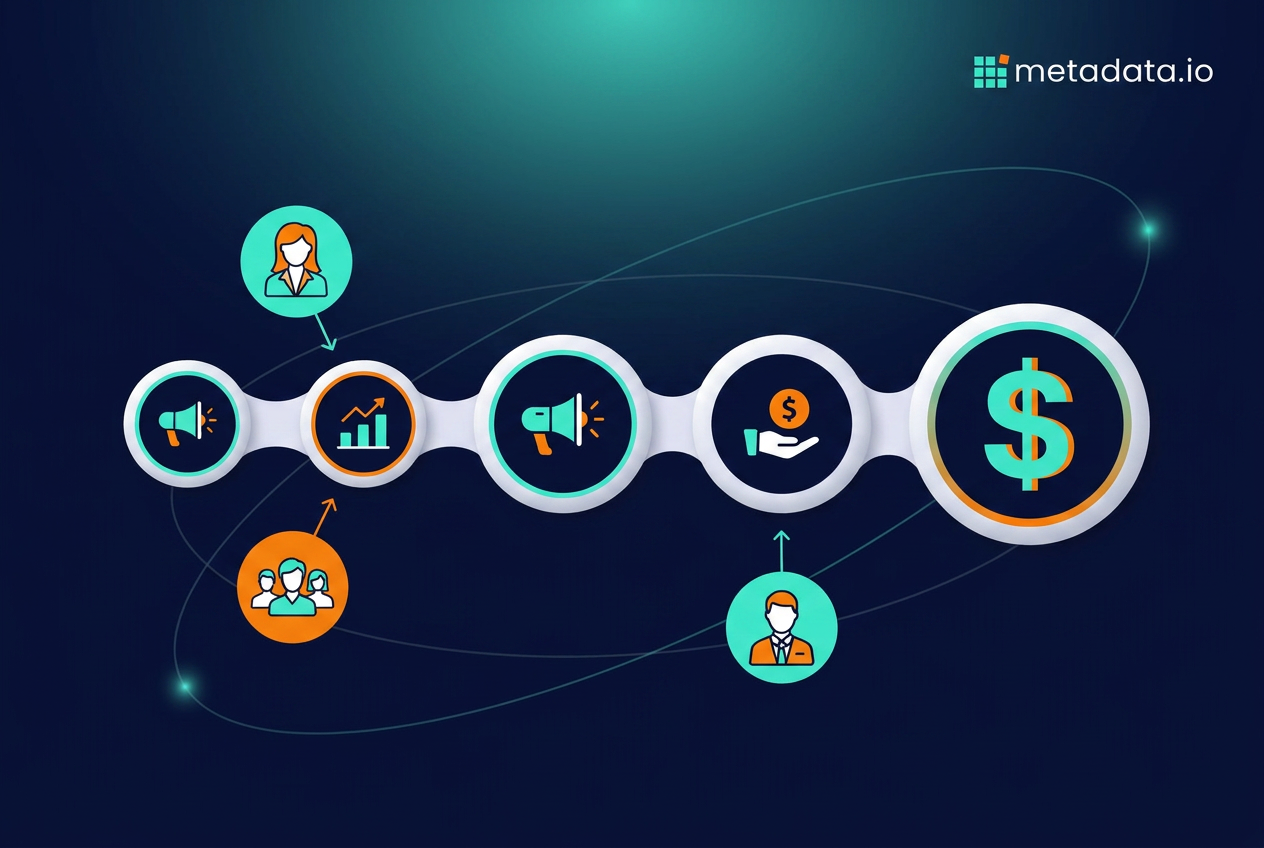
A marketing pipeline isn’t a straight line where prospects magically turn into customers. It’s more like a guided path where you help buyers get the information they need at each step. Here’s how it actually works.
This is where you get on the radar of companies that could actually become great customers. You’re not trying to reach everyone—just the accounts that fit your ideal customer profile (ICP).
Your ICP is a detailed description of the companies most likely to buy from you and stick around. It includes things like company size, industry, technology they use, and behavioral signals that show they’re in the market for what you sell.
At this stage, you’re running targeted ads, creating helpful content, and showing up where your audience hangs out. The goal is to start a conversation, not close a deal.
Once you have their attention, you need to build trust. This means giving away valuable information without asking for much in return—important when 75% of B2B buyers prefer a rep-free sales experience. You’re answering their questions, helping them understand their problem better, and positioning yourself as the expert.
This is where content really matters. Blog posts, webinars, guides, and case studies all help prospects move forward in their thinking. The more helpful you are, the more likely they are to remember you when they’re ready to buy.
During this stage, you’re also watching what they do:
Are they visiting your pricing page?
Did multiple people from the same company download your buyer’s guide?
Are they engaging with your ads across different channels?
These signals tell you how interested they really are.
This is the moment when marketing hands an account to sales—but not because one person filled out a form. An account becomes sales-ready when you see clear signs that multiple people at the company are actively researching solutions.
Now the deal is officially in the sales pipeline, but marketing’s job isn’t over. You can support the sales team by running targeted ads to keep your brand visible, sharing relevant case studies, and creating content that addresses common objections.
This continued support helps sales close deals faster and at higher win rates. When marketing and sales work together through the entire cycle, everyone wins.
The pipeline doesn’t stop when someone signs a contract. Your existing customers are often your best source of new revenue through upsells, cross-sells, and renewals.
You can use the same pipeline marketing principles to identify expansion opportunities. Track how customers are using your product, what features they’re engaging with, and when they might be ready for the next tier. Then reach out with relevant offers before they even ask.
If you want to run pipeline marketing the right way, you need to track metrics that actually matter. Forget impressions and click-through rates. Here’s what you should be watching.
This is the total dollar value of all sales opportunities that came from your marketing efforts. It’s the clearest way to show your impact in language everyone understands: revenue, which is why 62% of marketers now report pipeline generated as their top metric.
If you’re generating $2M in marketing sourced pipeline each quarter and your win rate is 25%, you’re directly responsible for $500K in closed revenue. That’s a number your CFO cares about.
Pipeline velocity tells you how fast deals move from first contact to closed-won. A faster velocity means shorter sales cycles and quicker revenue.
You calculate it by multiplying your number of opportunities, average deal value, and win rate, then dividing by the length of your sales cycle in days. If this number is going up, you’re doing something right.
Your average deal value shows you which campaigns and channels are bringing in the biggest opportunities. If you notice that deals from a specific campaign tend to be 2x larger than others, you know where to invest more budget.
Win rate is the percentage of opportunities that actually close. If your win rate is climbing, it means you’re sending sales better-qualified accounts that are a good fit for your product.
A low win rate might mean you’re passing opportunities too early or targeting the wrong accounts. Either way, it’s a signal to adjust your strategy.
CAC is how much you spend in sales and marketing to acquire one customer. The goal of pipeline marketing is to lower this number over time by focusing on the most effective channels and highest-value accounts—critical when costs have increased 60% over the past five years.
If your CAC is $10K and your average customer lifetime value is $50K, you’re in good shape. But if those numbers are reversed, you’ve got a problem.
Building a pipeline marketing strategy takes planning, but it’s not rocket science. Here’s how to get started.
You can’t build pipeline if you don’t know who you’re targeting. Your ICP should go beyond basic demographics like company size and industry.
Think about:
What technology do they already use?
What problems are they actively trying to solve?
What does their buying process look like?
Who are the decision-makers and influencers?
The more specific you get, the better you can target your efforts.
Once you know who you’re targeting, figure out how they actually buy. What questions do they ask at each stage? What information do they need? Where do they go to find answers?
This buyer journey map becomes your blueprint for content and campaigns. If you know prospects are comparing solutions in the middle of their journey, create comparison guides. If they need executive buy-in at the end, create ROI calculators.
To execute pipeline marketing, you need all your data in one place. Your marketing data pipeline connects your CRM, marketing automation platform, ad accounts, and website analytics into a single view.
This unified data lets you see the full picture of how accounts are engaging with you across every channel. Without it, you’re flying blind.
Don’t waste budget on channels just because everyone else is using them. Pick the channels where your ICP actually spends time.
For B2B, that might mean:
LinkedIn for professional targeting
Google Search for capturing intent
Industry-specific communities or forums
Even pipeline social media strategies on platforms like Reddit or Facebook if that’s where your buyers are
Use your buyer journey map to create content that answers questions at each stage. Someone just learning about their problem needs different content than someone comparing vendors.
Top of funnel might be blog posts and educational videos. Middle of funnel could be webinars and comparison guides. Bottom of funnel is case studies and product demos.
You can’t manually test every combination of ad creative, audience, and channel. The math doesn’t work.
The only way to find what drives pipeline is to automate your testing. Run experiments across audiences, creative variations, and bidding strategies simultaneously. Then automatically shift budget to what’s actually generating revenue, not just clicks.
This is where platforms like Metadata come in. Instead of spending your days adjusting bids and swapping out ad creative, AI agents handle the optimization while you focus on strategy and creative direction.
Pipeline marketing is about changing your role from campaign manager to revenue driver. It’s about proving that marketing isn’t a cost center—it’s a growth engine.
The future isn’t about doing more manual work. It’s about letting technology handle the repetitive stuff so you can focus on understanding your customer, crafting better stories, and building strategies that actually grow the business.
When you make this shift, something interesting happens. You stop defending your budget and start getting asked how much more you need to hit the company’s revenue goals. That’s when marketing gets fun again.
Frequently Asked Questions (FAQ)
How long does it take to see results from pipeline marketing?
What's the difference between a marketing qualified lead and a marketing qualified account?
Can small marketing teams implement pipeline marketing effectively?
How do you align sales and marketing teams around pipeline goals?
What tools do you need to run pipeline marketing?
How is pipeline marketing different from account-based marketing?