Manual ad testing is slow, expensive, and forces you to guess which campaigns will actually work. This guide shows you how AI ad testing runs hundreds of experiments at once, automatically shifts budget to what’s driving revenue, and finds winning combinations you’d never have time to test manually.
What is AI ad testing anyway
AI ad testing is when artificial intelligence automatically creates, launches, and analyzes hundreds or thousands of ad variations to find what actually drives revenue, delivering 22% better ROI than traditional methods. This means instead of you manually testing two headlines against each other for three weeks, the AI tests every possible combination of your creative, copy, audiences, and offers all at once.
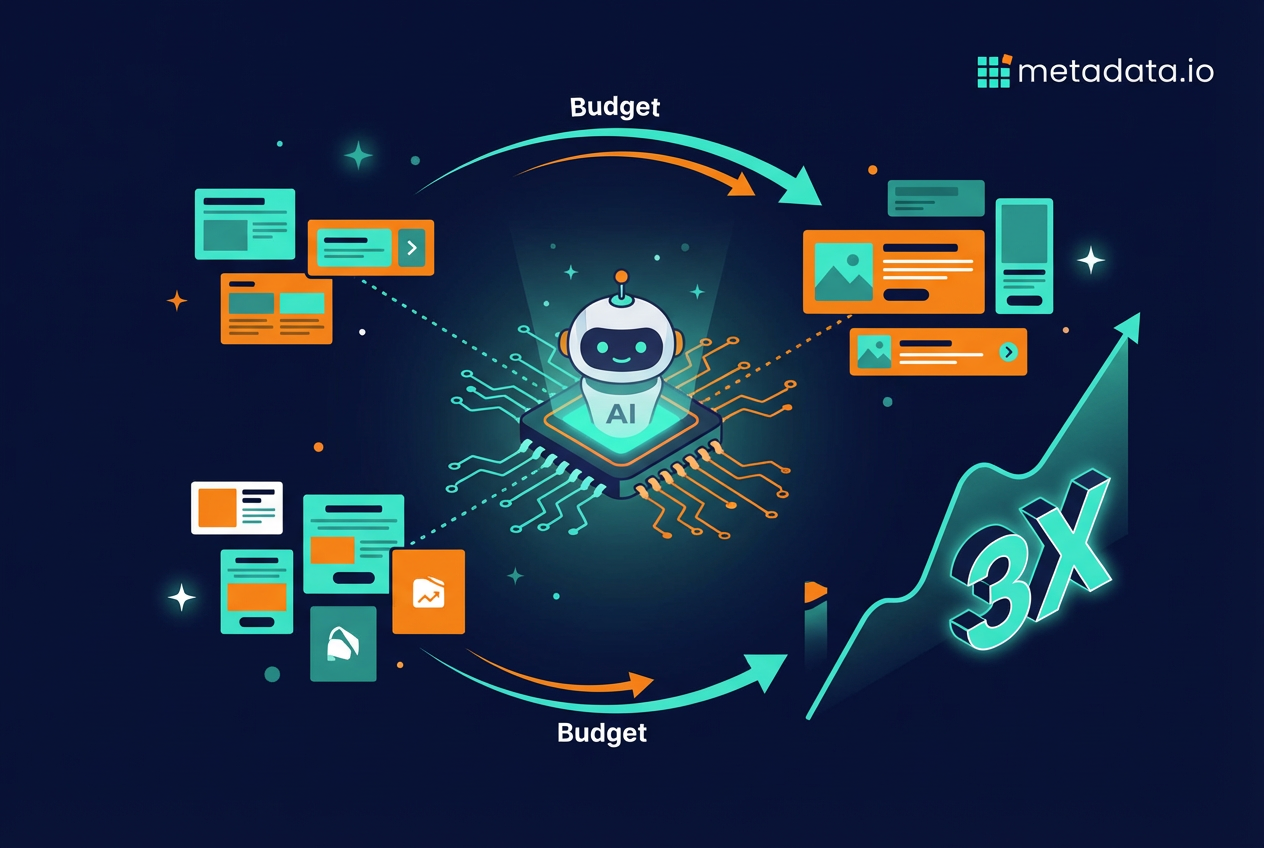
Here’s the difference. Traditional A/B testing means you pick two versions of an ad, run them both, wait for weeks, and hope one clearly wins. AI ad testing launches hundreds of these experiments simultaneously, watches the results in real time, and automatically moves your budget to what’s working while shutting off what isn’t.
The AI doesn’t just look at clicks or impressions. It connects to your CRM to see which ads led to actual demos, qualified leads, and closed deals. Then it keeps running more experiments based on what it learned, getting smarter every day.
Why manual ad testing is a waste of your time
Manual ad testing is broken. You already know this because you’ve lived it.
You spend hours building two ad variations. You launch them. Then you wait. By the time you have enough data to make a decision, the quarter’s almost over. And half the time, the results are inconclusive anyway, even though marketers waste 10 hours weekly on manual tasks like these. And half the time, the results are inconclusive anyway.
Here’s what actually happens. You look at your spreadsheet and see that Ad A had a slightly lower cost per click, but Ad B had more clicks overall. Neither one clearly won. So you make your best guess, launch another test, and the cycle repeats. Meanwhile, your budget is bleeding out on campaigns that might not even be reaching the right people.
The real problem is you can only test a tiny fraction of what matters. You test one headline against another headline. But what about the image? The audience? The offer? The landing page? There are hundreds of combinations that could work better, but you’ll never have time to test them all manually.
And if you’re in B2B, it gets worse. You’re not selling impulse purchases. You need to reach specific accounts, influence multiple stakeholders, and track results through a long sales cycle. A high click-through rate means nothing if those clicks aren’t coming from your ideal customer profile.
How AI ad testing finds winning campaigns faster
AI ad testing works by doing all the manual work for you. You give it your creative assets, copy variations, and audience lists. The AI then builds every possible campaign combination and launches them across your ad channels.
But here’s where it gets interesting. The AI doesn’t just launch campaigns and walk away. It watches performance data constantly and makes adjustments every single day.
- Real-time budget shifts: If one ad combination is generating qualified leads at half the cost of another, the AI automatically moves more budget to the winner.
- Continuous learning: Every click, conversion, and closed deal teaches the AI something new about what works for your specific audience.
- Revenue-focused decisions: Instead of optimizing for vanity metrics, the AI looks at which ads are actually driving pipeline and revenue in your CRM.
This creates a feedback loop that gets smarter over time. The AI might discover that your “efficiency” messaging works better than your “cost savings” messaging, but only for mid-market companies in healthcare. It then automatically creates more variations based on that insight and keeps testing.
Think of it like having a team of fifty people running experiments around the clock. Except they never sleep, never make mistakes copying data between platforms, and they only care about one thing: finding the exact combination of creative, copy, and audience that generates the most revenue per dollar spent.
What you can actually test with AI
A real AI ad testing platform doesn’t just swap out images. It systematically tests every component of your campaign to find what actually moves the needle.
Ad creative
This is the obvious one. You upload multiple images, videos, or GIFs, and the AI tests each one against every headline and audience combination. It figures out which visuals grab attention and which ones get ignored.
But it goes deeper than that. The AI can identify patterns like “video ads outperform static images for enterprise accounts” or “bright colors work better on Meta but professional photography works better on LinkedIn.” You’d never have time to discover these insights manually.
Audience targeting
This is where AI testing becomes a massive advantage for B2B marketers. You’re not limited to testing “VP of Marketing” against “Director of Marketing.” You can test hyper-specific audiences that actually matter to your business.
You can test audiences like:
- Your top 100 target accounts
- People who visited your pricing page in the last 30 days
- Contacts in your CRM who opened your last email but didn’t book a demo
- Companies using a specific technology that makes them a good fit
- Lookalikes of your best customers based on firmographic data
The AI runs each of these audiences against your creative and copy variations to find which segments respond best to which messages. This is how you stop wasting budget on broad audiences and start reaching the exact people who are most likely to buy.
Ad copy and headlines
Should your headline focus on saving time or saving money? Should your body copy be short and punchy or detailed and informative? You don’t have to guess anymore.
Write three to five different headlines and a few variations of body copy. The AI mixes and matches them with your creative and audiences to find the highest-performing combinations. It might discover that your “save time” headline works great for small businesses but your “increase revenue” headline crushes it with enterprise accounts.
Offers and landing pages
The offer you’re promoting matters just as much as the ad itself. You can test different calls to action and destinations to see what actually converts.
For example, you could test “Book a Demo” going to a calendar page versus “Download the Guide” going to a gated landing page. Or test “Start Free Trial” versus “See a Product Tour.” The AI optimizes for whichever offer generates the most qualified leads and pipeline, not just the most clicks.
What to look for in an ad testing platform
Not every platform that mentions AI is actually doing real AI ad testing. Some are just basic automation tools with fancy marketing. If you want a platform that actually drives results, here’s what it needs to have.
1. Connects to your CRM
This is non-negotiable. If your ad platform can’t see what happens after someone clicks your ad, it’s optimizing for the wrong thing.
A real integration with Salesforce or HubSpot means the AI can see which ads led to qualified opportunities, which ones brought in junk leads, and which ones influenced deals that eventually closed. Without this connection, you’re just optimizing for cheap clicks. With it, you’re optimizing for revenue.
2. Automates experiment execution
The platform should build the campaigns for you. You upload your assets—creative, copy, audiences—and the AI automatically constructs hundreds of campaign variations and launches them across your channels.
If you’re still manually building every campaign in the ad platform interface, you’re not really using AI. You’re just using a tool with some smart features. Real automation means the AI does the grunt work while you focus on strategy.
3. Tests more than just creative
Creative testing is important, but it’s only one piece. The biggest performance gains often come from testing different audiences with different messages.
Your platform needs the ability to test creative and copy against dozens of distinct audience segments. This is how you discover that your product demo video works great for IT directors but your customer testimonial video works better for CFOs.
4. Provides audience intelligence
A great platform doesn’t just test the audiences you give it. It helps you discover new ones.
It should analyze your CRM data and campaign performance to identify patterns in your best customers. Maybe it notices that companies with 200-500 employees in the manufacturing industry convert at twice the rate of other segments. Now you have a new high-value audience to target.
How to get started with automated creative testing
Switching from manual testing to AI doesn’t have to be complicated. Here’s how to do it.
Step 1: Set a clear goal
Pick one specific business outcome you want to improve. Not “increase engagement” or “boost awareness.” Pick something concrete like “book 50 qualified demos this quarter” or “generate 100 free trial sign-ups.”
Your goal needs to be something you can track in your CRM or marketing automation platform. This is what the AI will optimize for.
Step 2: Gather your assets
Collect the raw materials for your experiments. You need at least three to five different images or videos, three to five headlines, and two to three variations of body copy.
Don’t overthink this part. You’re not trying to create the perfect ad. You’re creating a variety of options for the AI to test. Some will work, some won’t, and that’s the whole point.
Step 3: Define your audience segments
Build out a few distinct audiences to test against each other. Start with something simple like a broad audience based on job titles and a more targeted audience built from your list of dream accounts.
As you get more comfortable, you can add audiences based on intent signals, CRM data, or website behavior. The key is giving the AI different segments to compare so it can find where your message resonates most.
Step 4: Let the AI run
Load your goal, assets, and audiences into the platform and launch. The AI takes over from here, building all the campaign variations and running them across your channels.
Your job for the first week or two is to do nothing. Let the system gather data. Resist the urge to log in every day and start making manual changes. The AI needs time to learn what works.
Step 5: Analyze revenue impact not just clicks
After your campaigns have been running for a couple weeks, look at the results. But don’t just look at the ad platform dashboard showing clicks and impressions.
Look at the data inside your AI ad testing platform that’s pulling from your CRM. Which specific combination of creative, copy, and audience is generating the most pipeline? Which one has the lowest cost per qualified opportunity? Use those insights to inform your next round of campaigns.
Stop guessing and start generating revenue
Manual ad testing forces you to make decisions based on incomplete data. You never have enough time or resources to test what really matters. You launch campaigns, cross your fingers, and hope they work.
This is why Metadata exists. The platform automates the entire experimentation process so you can stop living in spreadsheets and ad platform interfaces. AI agents run thousands of campaign experiments and use data directly from your CRM to optimize for revenue, not vanity metrics.
This is how B2B companies like Zoom and Docebo stopped wasting budget on ads that don’t work and started generating predictable pipeline from their paid campaigns, joining the 80% of automation users who’ve seen increased leads. The AI handles the execution and optimization while you focus on strategy and creative direction.
If you’re tired of guessing which ads will work and ready to let AI do the heavy lifting, book a demo. See how automated ad testing can change the way you run campaigns.