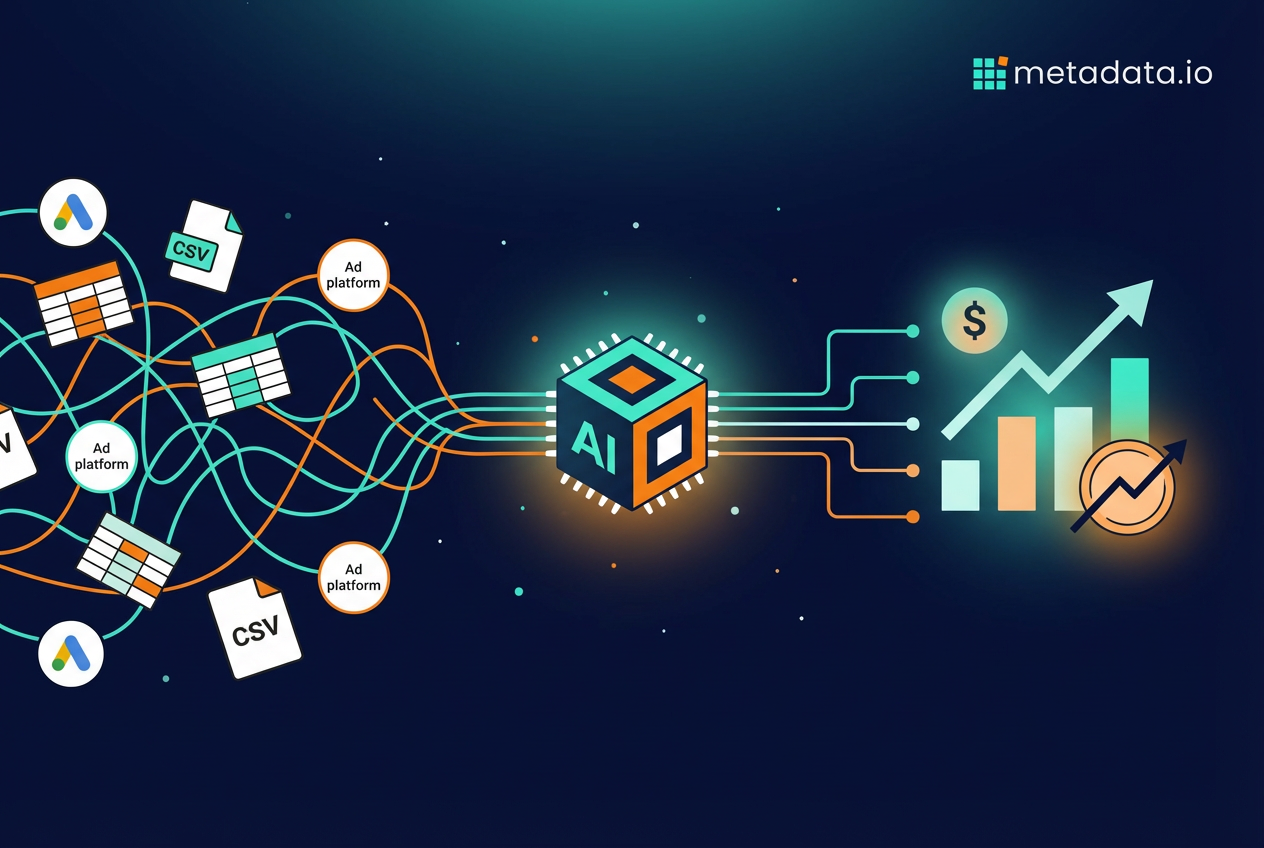
Campaign optimization should be straightforward—test what works, kill what doesn’t, and spend your budget smarter. But if you’re spending serious money on ads, you already know it’s actually a mess of manual work, disconnected data, and impossible attribution that keeps you stuck in spreadsheets instead of thinking about strategy.
Why optimizing campaigns is such a headache
Campaign optimization is the process of improving your marketing campaigns to get better results from the same budget. This means testing different audiences, adjusting your ad creative, changing your bids, and reallocating spend to what’s working.
The problem? Doing this well requires you to juggle messy data from a dozen platforms, make constant adjustments based on performance, and somehow prove that every dollar you spend turns into actual revenue. Most marketers spend more time pulling reports and updating spreadsheets than actually thinking about strategy.
You’re stuck in a reactive loop. You pull last week’s data to make this week’s decisions, always feeling one step behind. And when your boss asks what’s working, you’re left scrambling to connect the dots between ad spend and closed deals.
The biggest marketing campaign optimization challenges
Let’s get real about why campaign optimization is so difficult. It’s not because you’re not smart enough or working hard enough. The system is set up to make this nearly impossible to do well at scale.
1. Manual execution is slowing you down
Say you want to test five different ad creatives against three audiences on two platforms. That’s 30 campaign variations you need to build, launch, and monitor by hand. Each one requires you to log into the platform, set up targeting, upload creative, configure budgets, and write tracking parameters.
This manual work is the single biggest bottleneck to better performance. You know more testing would lead to better results, but you simply can’t move fast enough. So you settle for running a handful of tests and hoping you get lucky.
Your days get eaten up by tactical execution instead of strategic thinking. You’re building campaigns when you should be figuring out which markets to enter or what messaging will resonate with your buyers.
2. You’re targeting the wrong people
You have a crystal-clear Ideal Customer Profile. You know their job titles, company size, industry, and the technology they use. Getting that precise audience in front of your ads is another story entirely.
LinkedIn targeting works okay, but it’s expensive and your buyers don’t spend all their time there. You know they’re scrolling Facebook, watching YouTube, and browsing websites. But those platforms were built for B2C advertisers selling shoes and meal kits.
You’re stuck using broad categories like "interested in business software" and crossing your fingers. This leads to wasted spend on people who will never buy from you and a flood of low-quality leads that your sales team ignores.
3. Your data is a complete mess
Your marketing data lives in separate silos that don’t talk to each other. Campaign performance sits in Google Ads and LinkedIn. Lead information lives in your marketing automation platform. Deal data is locked in your CRM.
Trying to stitch it all together to get a clear picture is a nightmare. You export a CSV from one system, clean it up in Excel, then manually upload it to another platform. By the time you’re done, the data is already outdated.
Even worse, the data quality is terrible. You pull a list from your CRM to build an audience, but half the contacts have outdated job titles or missing company information. Bad data leads to bad targeting, which leads to bad results.
4. You can’t prove what’s actually working
Your boss asks a simple question: "What was the ROI on that campaign?" You freeze.
You can show clicks, impressions, and cost-per-lead. But connecting that spend directly to a closed-won deal in your CRM feels impossible. Did that LinkedIn ad lead to a demo request that turned into a deal six months later? Maybe. Probably. You think so.
This attribution gap is where marketing budgets go to die. Without a clear line from ad spend to revenue, you can’t justify your budget, double down on what’s working, or kill what isn’t. You’re making decisions based on gut feelings instead of actual business impact.
How AI fixes campaign optimization challenges
The answer isn’t to work harder or hire more people. The answer is letting technology handle the manual, repetitive tasks that are eating up your time and limiting your results.
It automates thousands of campaign experiments
AI agents can run thousands of variations on audiences, creative, bids, and budgets at the same time. They work 24/7, analyzing real-time performance data to find winning combinations you’d never discover manually.
This means you can test every variable without lifting a finger. The system automatically moves budget to top-performing experiments while shutting down the losers. Your ad spend is always working as efficiently as possible.
Think about it this way: you might run 10 A/B tests in a month. An AI system runs 10,000 experiments in the same time period. It’s not even close.
It finds your ideal buyers everywhere
AI platforms solve the B2B targeting problem on B2C channels. They connect to your CRM and other data sources to build hyper-specific audiences based on your actual customer data, firmographics, and technographics.
You can target a precise list of accounts and job titles from your ICP on Facebook. You can reach decision-makers at mid-market SaaS companies on YouTube. You can show ads to people who match your best customers on Reddit.
This gives you a massive competitive edge. While your competitors are stuck with LinkedIn’s high CPMs or Facebook’s broad targeting, you’re reaching your ideal buyers wherever they spend time online.
It cleans and connects your data
A good AI platform acts as a central hub for all your marketing data. It integrates with your ad channels, marketing automation, and CRM to create a single source of truth.
The system enriches your existing data, filling in missing firmographic details and keeping information up-to-date. When someone changes jobs or a company gets acquired, your audience lists automatically reflect those changes.
Clean, connected data makes everything else easier:
- Your targeting becomes more precise
- Your reporting becomes more accurate
- Your decisions become smarter
It ties every dollar to pipeline and revenue
By connecting directly to your CRM, an AI platform can see which campaigns, ads, and audiences aren’t just generating clicks—they’re creating qualified opportunities and closed-won deals.
This is the holy grail of B2B marketing attribution. You can finally answer that question from your boss with confidence. You can show exactly which campaigns drove pipeline and revenue, not just vanity metrics like impressions and clicks.
The system automatically shifts budget away from campaigns that generate cheap but useless leads. It doubles down on the campaigns driving real business impact. You’re optimizing for what actually matters.
| What you do manually | What AI does for you |
|---|---|
| Run a few A/B tests per month | Run thousands of experiments 24/7 |
| Use broad targeting on B2C platforms | Target your exact ICP everywhere |
| Stitch together data from separate tools | Work from a single source of truth |
| Report on clicks and leads | Report on pipeline and revenue |
Practical campaign optimization tips you can use
While AI provides a powerful solution, there are foundational steps you can take right now to improve your results. These practices will make you better at campaign optimization whether you’re working manually or with an automated system.
1. Define what a good lead actually is
Get in a room with your sales team and agree on a concrete definition of a marketing-qualified lead and a sales-qualified lead. Write it down. Make it specific.
This alignment is critical. If marketing is optimizing for one type of lead and sales wants another, your campaigns are doomed from the start. You’ll generate tons of leads that sales ignores, then wonder why you’re not hitting your pipeline targets.
A good lead definition includes firmographic criteria (company size, industry, revenue), demographic criteria (job title, seniority), and behavioral criteria (downloaded a whitepaper, attended a webinar). Get specific.
2. Get obsessive about your audience
Don’t just rely on the predefined audiences in the ad platforms. Those are built for the masses, not for your specific ICP.
Build custom audiences from your CRM data. Export your best customers and create lookalike audiences based on their characteristics. Use exclusion lists to stop showing ads to current customers, competitors, or people who already converted.
The more effort you put into audience creation, the better your campaign performance will be. This is where the magic happens in B2B advertising.
3. Test your creative and copy relentlessly
Never assume you know what will resonate with your audience. What you think is clever might fall flat. What seems boring might convert like crazy.
Test different headlines, images, videos, and calls to action. Try long-form copy against short-form. Test testimonials against product screenshots. Even small changes can have a big impact on your results.
If you’re doing this manually, aim to launch new creative tests weekly. An automated system can test variations daily and find winners faster than you ever could on your own.
4. Set up your advertising monitoring and optimization
Don’t just launch campaigns and forget about them. You need a regular process for reviewing performance, spotting trends, and making adjustments.
At a minimum, check your key metrics weekly. Look for campaigns that are spending budget but not delivering results. Find audiences that are performing well and deserve more investment. Identify creative that’s getting stale and needs to be refreshed.
This process of advertising monitoring and optimization is the foundation of getting better results over time. It’s not sexy, but it works.
Stop tweaking spreadsheets and start thinking strategy
The goal of marketing isn’t to be the best at building campaigns in Google Ads. The goal is to generate revenue for your business.
For too long, marketers have been trapped in the tactical weeds. You spend all your time on manual execution—building audiences, uploading creative, adjusting bids, pulling reports. There’s no time left for the strategic work that actually moves the needle.
By offloading the repetitive, low-value work to technology, you can finally reclaim your time. You can think about brand positioning and messaging. You can talk to customers and understand what makes them buy. You can collaborate with sales to improve the handoff process.
This is what marketing should feel like. Strategic. Creative. Impactful.
If you’re tired of the manual grind and ready to see how automation can help you generate more pipeline from your ad spend, you might want to see how Metadata works. The platform handles campaign execution, targeting, and optimization across all major paid channels so you can focus on strategy instead of spreadsheets.
Benchmark context: across 153 B2B advertisers and $57.6M of 2025 ad spend, Metadata's 2026 B2B Paid Media Benchmark reports what a LinkedIn lead actually cost, and how that varied by ad format, audience and offer type.