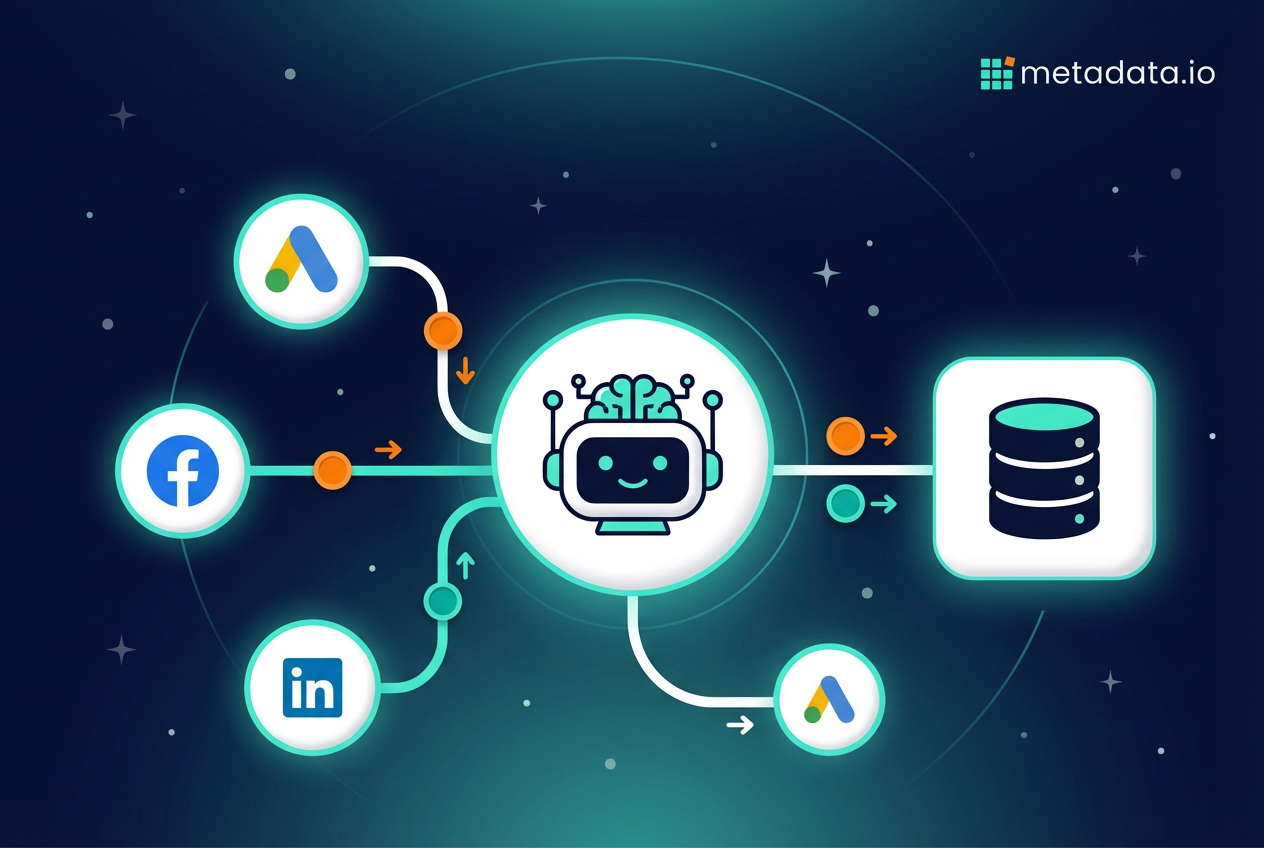
Most B2B marketers are still building campaigns the same way they did five years ago… manually targeting audiences, adjusting bids, and hoping the leads that come in are actually qualified. This guide shows you how to build an AI go-to-market strategy that automates the busywork and focuses your budget on what actually generates pipeline and revenue.
What is an AI go-to-market strategy
An AI go-to-market strategy is a system that uses artificial intelligence to automate how you find, target, and convert customers. This means instead of manually building audiences, launching campaigns, and adjusting budgets, AI does it for you based on real performance data.
Think of it like having a team working 24/7 to run experiments on your campaigns. The AI tests different audiences, ad creative, and budget allocations across all your paid channels. It learns what works and automatically does more of that while cutting what doesn’t.
The difference between this and traditional GTM marketing is speed and scale. You used to launch one campaign, wait a month, analyze the results, then make changes. Now you can run hundreds of experiments at once, and the AI adjusts in real time based on what’s actually driving pipeline and revenue.
Here’s what makes it different from the old way:
- Targeting: AI builds audiences based on your actual closed-won customers, not your best guess about who might buy.
- Execution: Campaigns launch and optimize themselves across multiple channels without you touching each platform.
- Budget: Money automatically flows to the ads and audiences generating qualified opportunities, not just clicks.
- Measurement: You see which campaigns are creating revenue, not just vanity metrics like impressions.
Why your traditional GTM strategy isn’t working anymore
Your current go-to-market strategy probably looks like this: You spend weeks building a plan, create some buyer personas, launch campaigns on LinkedIn and Google, then hope the leads that come in are actually qualified. Spoiler alert—most aren’t.
The problem is you’re making decisions based on gut feelings and outdated data. By the time you analyze last month’s campaign performance and make adjustments, the market has already moved on. You’re always playing catch-up.
And let’s talk about the manual work. Your team is buried in spreadsheets, trying to figure out which campaigns are actually working. You’re logging into five different ad platforms, copying audience lists, adjusting bids, and trying to connect all this activity back to closed deals in your CRM. It’s exhausting and inefficient.
This approach leads to three big problems. First, you waste money targeting people who will never buy from you—only 25% of marketing-generated leads possess sufficient quality to advance to sales. Second, you can’t move fast enough to capitalize on what’s working. Third, you can’t prove to your CFO that marketing is actually generating revenue, not just burning budget.
The old GTM playbook was built for a slower world. Today’s B2B buyers research on their own timeline across multiple channels. If you’re still manually managing campaigns the way you did five years ago, you’re already behind.
The core components of a modern GTM strategy
A modern go-to-market strategy has five pieces that work together. Each one builds on the last, creating a system that gets smarter over time.
Redefining your ideal customer profile
Your ICP isn’t a document you write once and forget about. It’s a living profile based on your actual best customers—the ones with the highest lifetime value and fastest sales cycles.
AI analyzes your CRM data to identify patterns in your closed-won deals. It looks at company size, industry, technology stack, and buying behavior to build a precise picture of who you should target. This goes way beyond “VP of Marketing at a SaaS company with 50-200 employees.”
The key is using real data, not assumptions. You might think you know your ideal customer, but the data often tells a different story. Maybe your fastest deals come from a segment you’ve been ignoring. Or maybe the personas you’ve been targeting have terrible conversion rates.
Automating audience segmentation and targeting
Once you know who to target, you need to find them across every channel they use. Manually building audiences for LinkedIn, then rebuilding similar audiences for Google, then doing it again for Meta is a waste of time.
A modern GTM strategy syncs your audiences across all platforms automatically. You define your target accounts and personas once, and the system creates the right audiences for each channel. This means you can reach your ideal buyers on traditionally B2C platforms like Meta with the same precision you get on LinkedIn.
Some platforms use special audience-building technology that layers firmographic, technographic, and intent data on top of your first-party data. This gives you B2B targeting capabilities even on channels that weren’t built for it.
Personalizing content and creative at scale
Your buyers expect ads that speak directly to their problems. But creating dozens of variations for every audience segment is impossible to do manually without a huge team.
AI helps by testing different messages, images, and offers against specific personas. It identifies which combinations drive engagement and conversions, then automatically shows more of what works. This means your CFO sees ads about ROI and cost savings while your VP of Marketing sees ads about efficiency and team productivity.
The goal isn’t to replace your creative team. It’s to help them focus on strategy and big ideas while the AI handles the execution and testing of variations.
Optimizing campaign execution and spend
This is where AI really earns its keep. Instead of checking campaign performance every morning and manually shifting budgets, AI agents do it for you around the clock.
They monitor performance against your actual business goals—pipeline generated, cost per opportunity, customer acquisition cost. If a campaign or audience isn’t performing, the budget automatically moves to the ones that are. No more wasted spend on ads that aren’t driving results.
Think about it this way: You’re probably spending $50k or more per month on paid ads. Would you rather have someone check in once a day to make adjustments, or have a system that optimizes every hour based on real-time performance data—potentially achieving 30% lower customer acquisition costs through automated optimization?
Measuring what actually matters
Impressions and clicks don’t pay the bills. A modern GTM strategy connects your ad spend directly to revenue by integrating with your CRM.
You can see exactly which campaigns influenced which deals. Not just “this campaign generated 100 leads” but “this campaign generated 12 qualified opportunities worth $450k in pipeline.” That’s the kind of reporting that gets your CFO’s attention.
This also means you can kill campaigns that look good on paper but aren’t actually driving revenue. Maybe a campaign has a great click-through rate but terrible lead quality. Without CRM integration, you’d keep running it because the metrics look good. With it, you’d see it’s not worth the spend.
How to create a go-to-market strategy with AI
Building an AI GTM strategy isn’t as complicated as it sounds. It’s about connecting your systems, defining your targets, and letting the AI handle execution. Here’s the step-by-step process.
Step 1: Integrate your data sources
Your strategy only works if your data is connected. Start by integrating your CRM (Salesforce, HubSpot, etc.) with your ad platforms (LinkedIn, Google, Meta).
This creates a closed loop where the AI can see which accounts and personas convert into customers, then use that information to find more like them. It can also push campaign performance data back to your CRM so you can see which ads influenced which deals.
Without this integration, you’re just guessing. With it, you’re making decisions based on actual revenue data.
Step 2: Define your target accounts and personas
Use your CRM data to build detailed profiles of your best customers. Look at firmographics like company size and industry, but also dig into technographics (what software they use) and intent signals (are they actively searching for solutions like yours).
The key is being specific. “Enterprise SaaS companies” isn’t specific enough. “Series B SaaS companies with 100-500 employees using Salesforce and Marketo, showing intent signals for marketing automation” is better.
Don’t just pick the biggest companies or the ones you wish you could close. Focus on the ones where you have the highest win rate and fastest sales cycle. Those are your real ideal customers.
Step 3: Launch multichannel campaign experiments
Don’t put all your budget into one big campaign. Instead, launch dozens or hundreds of small experiments across multiple channels, audiences, and creative variations.
The old way was to launch one campaign per channel with maybe three ad variations. The new way is to test everything at once and let the AI figure out what works. Maybe your CFO persona responds better on LinkedIn while your VP of Marketing persona converts better on Google. You won’t know until you test.
Here’s what changes:
| Traditional approach | AI approach |
|---|---|
| Build one audience per channel manually | Sync audiences across all channels automatically |
| Launch one campaign with 3-5 ad variations | Launch hundreds of micro-experiments simultaneously |
| Set budget and check back in a week | AI adjusts budget every hour based on performance |
| Guess which creative worked best | Get clear data on what drives pipeline |
| Manually pull reports from each platform | See all performance in one dashboard tied to revenue |
Step 4: Let AI agents optimize for pipeline
Once campaigns are live, the AI agents take over the manual work. They monitor performance constantly, analyzing which experiments are generating engagement from your target accounts—with AI-optimized campaigns generating 111% more incremental sales than manually managed ones.
Budget automatically shifts away from underperforming ads toward the winners. Bids adjust based on how likely an account is to convert. New audience segments get tested while old ones that stopped working get paused.
Your job isn’t to tweak bids or adjust budgets anymore. It’s to monitor the overall results and make strategic decisions based on what the data is telling you.
Step 5: Analyze results and iterate
With an AI GTM platform, your reporting focuses on business metrics, not marketing metrics. Look at pipeline generated, cost per opportunity, and revenue influenced.
Use these insights to inform your strategy. Maybe you discover a new persona that converts really well. Or you find that a certain message resonates across all channels. These are the strategic insights that help you grow faster.
The AI handles the execution, but you’re still responsible for the big picture. What markets should you enter? What product positioning resonates? What offers convert best? Those are the questions you should be spending your time on.
Common pitfalls of a digital go-to-market strategy
Moving to an AI GTM strategy is a big shift. Here are the mistakes that trip up most teams so you can avoid them.
Bad data ruins everything—costing organizations an average of $12.9 million annually according to Gartner research. If your CRM is a mess, the AI won’t know who to target. Before you start, clean up your data. Make sure your closed-won opportunities accurately reflect your best customers and that fields like company size and industry are filled out correctly.
Focusing on the wrong metrics kills momentum. Don’t fall back into measuring success by leads or MQLs. The whole point is to focus on revenue. Your primary KPIs should be pipeline generated, customer acquisition cost, and ROI. If you’re still celebrating a campaign because it generated 500 leads, you’re missing the point.
Not trusting the process slows you down. It’s hard to give up control. You’ll be tempted to jump in and manually override the AI’s decisions. Resist that urge. The system is making decisions based on more data points than you could ever analyze manually. Let it run and learn.
Treating it as “set it and forget it” wastes the opportunity. AI automates execution, but it doesn’t replace strategy. You still need to think about messaging, offers, and market positioning. The AI handles the “how,” but you’re responsible for the “what” and “why.”
Choosing a GTM AI platform that drives revenue
Not all “AI” platforms actually use AI. Some just automate a few basic tasks and slap an AI label on it. When you’re evaluating platforms, look for these capabilities.
First, it needs deep integration with your CRM. The platform should pull sales data to build audiences and push campaign performance data back to show which ads influenced which deals. Without this, you’re just creating another tool that doesn’t talk to the rest of your stack.
Second, look for true multichannel capabilities. Your buyers don’t live on just one channel. The platform should let you manage and optimize campaigns across all major paid channels from one place. If you’re still logging into five different ad platforms, you’re not really solving the problem.
Third, make sure the AI actually optimizes, not just automates. It should autonomously run experiments and reallocate budget based on performance against your pipeline and revenue goals. If it can’t do that, it’s just a fancy dashboard.
Finally, check if it can handle B2B targeting on traditionally B2C platforms. The ability to reach your ideal buyers on Meta or Reddit with the same precision you get on LinkedIn is a huge advantage. Most platforms can’t do this.
The end of manual marketing
The future of B2B marketing isn’t about working harder. It’s about working smarter by handing off the repetitive, low-value tasks to technology built for it.
An AI go-to-market strategy frees you from spreadsheets and campaign monitoring. It lets you focus on what you do best: understanding your customers, crafting compelling stories, and building a brand people want to buy from.
This is how you make marketing fun again. You get to focus on strategy and creativity while knowing your execution is being handled as efficiently as possible. No more restless nights wondering if your campaigns are working. No more scrambling to hit your pipeline targets. Just clear data showing what’s driving revenue and what’s not.
Ready to stop guessing and start generating revenue more efficiently? See how an AI GTM platform can automate your execution while you focus on strategy.
Benchmark context: across 153 B2B advertisers and $57.6M of 2025 ad spend, Metadata's 2026 B2B Paid Media Benchmark reports what a LinkedIn lead actually cost, and how that varied by ad format, audience and offer type.