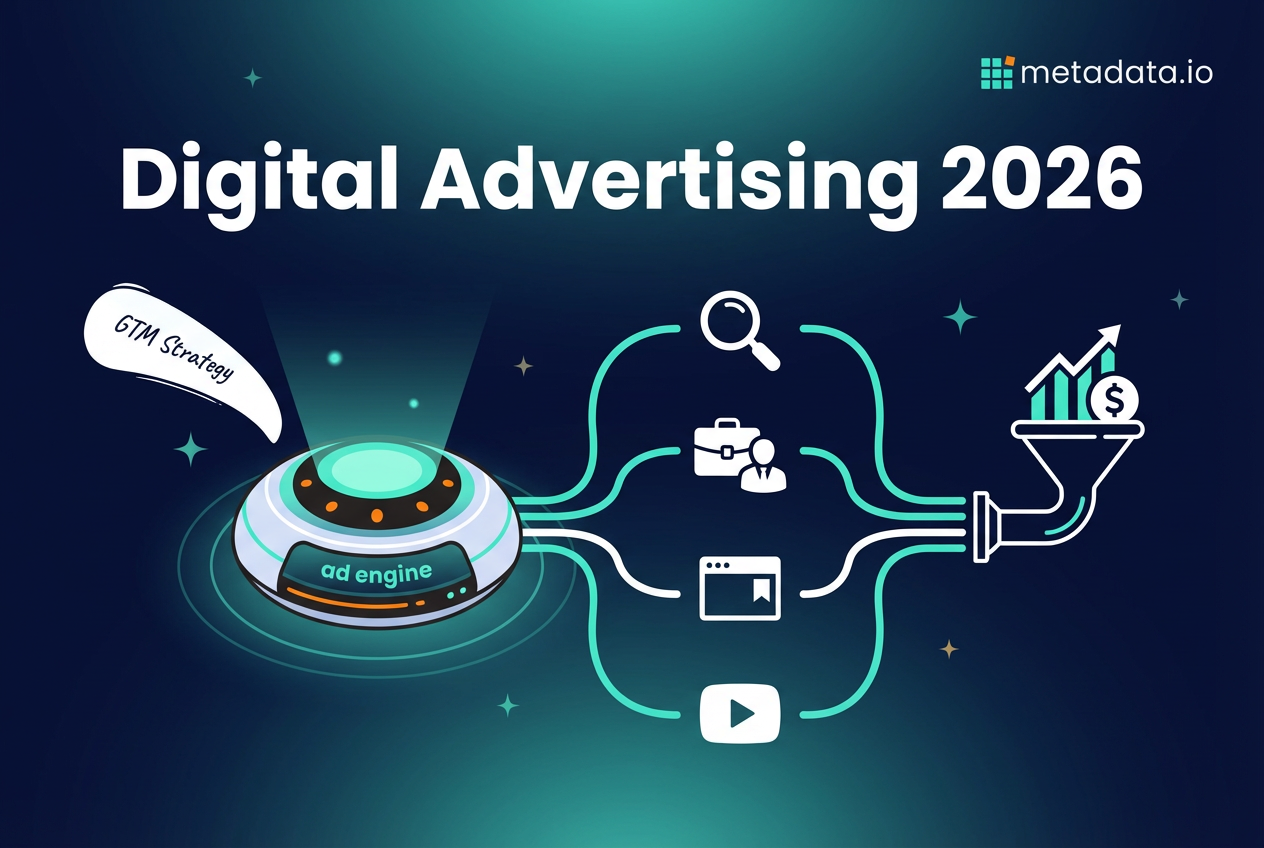
Digital advertising is how you pay to put your message in front of the right people on search engines, social media, and websites—and in 2026, it’s the fastest way to reach buyers who are already looking for what you sell. This guide covers everything B2B marketers need to know: what digital advertising actually is, why it matters, which platforms work for B2B, and how to run campaigns that generate pipeline and revenue instead of just clicks.
What is digital advertising
Digital advertising is paying to place your ads on online channels like search engines, social media, websites, and apps. This means you’re buying space to show your message to specific people who are likely to care about what you’re selling.
Think of it like renting a billboard, except instead of a highway, it’s on Google or LinkedIn. And instead of showing it to everyone who drives by, you only show it to people who fit your exact customer profile. That’s what makes it different from throwing money at a TV commercial and hoping the right person sees it.
The whole point is to get someone to take action—book a demo, download a guide, or buy your product. It’s the paid part of your digital marketing strategy, and when done right, it’s the fastest way to get in front of buyers who are already looking for what you offer.
Why digital advertising matters for your business
Your buyers are online right now. They’re researching problems on Google, scrolling LinkedIn during lunch, and reading industry blogs at night. If you’re not showing up in those moments, you don’t exist to them.
Digital advertising puts you directly in their path when they’re actually paying attention. Unlike traditional ads where you blast a message to everyone and hope it sticks, online advertising lets you target with precision. You can reach a VP of Sales at a company with 500 employees in the healthcare industry who visited your website last week. Try doing that with a magazine ad.
Here’s what makes it worth your time and budget:
- Targeting precision: Reach specific job titles at specific companies, not just anyone with a pulse.
- Real-time feedback: Know within hours if your ad is working or if you need to change it.
- Budget control: Start small, test what works, then scale up the winners.
- Clear measurement: Track every dollar spent and see exactly what it generated.
- Global reach: Run campaigns across multiple countries from your desk.
The biggest difference between digital and traditional advertising? You can actually prove what’s working. No more guessing if that conference sponsorship was worth it.
Types of digital advertising
You’ve got options when it comes to where you run your ads. The key is picking the channel where your buyers actually spend their time. Not all web based advertising is created equal, and what works for selling sneakers won’t work for selling enterprise software.
Here are the main types you need to know.
1. Search engine advertising
Search engine advertising is bidding on keywords so your ad shows up when someone searches for that term on Google or Bing. You only pay when someone clicks. This is also called pay-per-click or PPC.
For B2B, this is huge because the person searching has a clear problem right now. Targeted PPC campaigns capitalize on this intent by aligning every element with your audience’s immediate needs. When a prospect types "best CRM for real estate," they’re not browsing—they’re shopping. Showing up at that exact moment is how you get on their shortlist before they even know your competitors exist.
The downside? Everyone else wants that same spot, so popular keywords get expensive fast. You need to be smart about which terms you bid on and how much you’re willing to pay.
2. Social media advertising
Social media advertising means running paid ads on platforms like LinkedIn, Facebook, Instagram, and even Reddit. For B2B marketers, LinkedIn is the obvious choice because you can target by job title, company, industry, and seniority.
But here’s the problem with other platforms. Meta (Facebook and Instagram) and Reddit are built for B2C targeting based on interests and hobbies. You can’t natively target someone because they’re a Director of Marketing at a SaaS company with 200 employees. Their systems don’t work that way.
The workaround? Use a tool that lets you build audiences from your CRM data—like a list of target accounts or people who match your ideal customer profile—and then push those audiences to any channel. That’s how you make Meta or Reddit work for B2B without wasting money showing ads to random people.
3. Display advertising
Display advertising is those banner or image ads you see on the sides, top, or middle of websites. They’re great for building brand awareness and for retargeting people who already visited your site but didn’t convert.
The effectiveness depends entirely on where the ad shows up. Showing an ad for enterprise software on a celebrity gossip site is a waste. Showing it on an industry publication your ideal customer reads every morning? That’s smart.
Display ads work best when paired with retargeting. Someone visits your pricing page but doesn’t book a demo. Now they see your ad on every site they visit for the next two weeks, reminding them to come back.
4. Native advertising
Native ads are designed to blend in with the content around them. Think of a sponsored article on a news site or a promoted post in your LinkedIn feed. They don’t scream "I’m an ad," which is why people actually click on them.
Because they feel less disruptive, engagement rates are usually higher. The key is making sure the content you’re promoting is genuinely helpful, not just a thinly veiled sales pitch. If someone clicks expecting a useful article and gets a product page, they’ll bounce immediately.
5. Video advertising
Video advertising includes ads that run before, during, or after videos on YouTube, or as standalone video posts on LinkedIn and other social feeds. Video is powerful because it grabs attention in a crowded feed and lets you tell a story in 30 seconds.
You can show your product in action, share a customer success story, or explain a complex concept in a way that’s easy to understand. Just keep it short. If your video is longer than a minute, most people won’t watch the whole thing.
How digital advertising works
It might seem complex at first, but the basic mechanics of most digital ad platforms are pretty similar. It all comes down to a few core concepts that determine who sees your ad and how much you pay for it.
This is how most technological advertising gets from your screen to your customer’s.
The bidding process
Most digital advertising operates on an auction system. You’re bidding against other advertisers for the chance to show your ad to a specific person. This happens in real-time, which is why it’s called real-time bidding or RTB.
You set a maximum amount you’re willing to pay for a click (cost per click or CPC) or for a thousand impressions (cost per mille or CPM). The platform’s algorithm then looks at your bid, the quality of your ad, and how relevant it is to the person seeing it. The highest bidder doesn’t always win—the platform wants to show ads that people will actually engage with.
Audience targeting
This is where digital advertising separates itself from traditional methods. Instead of showing your ad to everyone, you choose exactly who sees it based on specific criteria.
You can target based on:
- Demographics like age, gender, and location
- Interests based on browsing behavior and engagement
- Past actions like visiting your website or downloading a guide
- Firmographics like company size, industry, revenue, and job titles
The real challenge for B2B is that most platforms are weak on firmographics. LinkedIn is the exception, but everywhere else, you need a way to bring your own audience data to the table.
Campaign optimization
Launching a campaign is just the beginning. The real work is in optimization—constantly tweaking your digital ad campaigns to improve performance.
This means monitoring results and making adjustments. You might change your ad copy, test a new image, adjust your bids, or move budget from a low-performing audience to a high-performing one. Manually doing this across dozens of campaigns is exhausting, which is why automation isn’t optional anymore.
How B2B digital advertising is different
You can’t run ads for a $100k software contract the same way you run ads for a $20 t-shirt. The entire game is different in B2B, and if you use a B2C playbook, you’re going to waste a lot of money.
Here’s why.
Smaller audience size
You’re not trying to reach millions of people. You might be trying to reach a few thousand specific people who hold a specific job title at a specific list of companies. Your total addressable market is tiny compared to B2C, which makes precise targeting absolutely critical.
Longer sales cycles
No one impulse-buys enterprise software. The journey from first click to signed contract can take six months or more and involve multiple touchpoints. Your advertising needs to support that entire journey, from initial awareness all the way to final consideration.
Higher customer lifetime value
Because the deals are bigger, each customer is worth a lot more. This means you can afford to spend more to acquire them, but it also raises the stakes. You need to be absolutely sure your ad spend is actually influencing these high-value deals, not just generating junk leads.
Buying by committee
You’re rarely selling to just one person. You’re selling to a committee of 6.3 stakeholders: the end-user, their manager, the finance person, the IT security person, and the executive who signs the check. Your advertising needs to reach and persuade multiple personas within the same account using smart targeting approaches, which is a completely different challenge than convincing one person to buy a pair of shoes.
Common digital ad platforms
While there are hundreds of places to spend your money, a few major digital ad platforms dominate the landscape. For B2B, these are the ones you need to know.
Google Ads
Google Ads is the king of search advertising. It lets you run ads on Google Search, YouTube, and a massive network of partner websites called the Google Display Network. Its strength is capturing intent—reaching people who are actively searching for a solution like yours right now.
The downside is that everyone wants to be on Google, so competition is fierce and costs can get high fast. You need to be strategic about which keywords you bid on and how much you’re willing to pay per click.
LinkedIn Ads
LinkedIn is the go-to platform for B2B social media advertising, offering formats like Conversation Ads that drive direct engagement with decision-makers. Its targeting capabilities are built for professionals, letting you zero in on job titles, company sizes, industries, and skills. It’s more expensive than other social platforms, but the audience quality is unmatched for B2B, generating 2x higher conversion rates compared to other social networks.
If you’re selling to decision-makers at mid-sized or enterprise companies, LinkedIn is where you need to be. Just be prepared to pay a premium for that access.
Meta Ads
Meta Ads includes Facebook and Instagram. While its targeting is primarily B2C-focused (based on interests and demographics), its reach is massive. The key to making Meta work for B2B is to bypass its native targeting entirely and bring your own audiences, built from your CRM or lists of target accounts.
When done right, Meta can be a cost-effective way to reach your buyers on a platform they’re already using every day. When done wrong, you’ll burn through budget showing ads to people who will never buy from you.
How to run successful digital ad campaigns
Running ads isn’t about setting a budget and hoping for the best. Successful campaigns are systematic and focused on results, not activity. It’s a process of continuous learning and improvement.
1. Set clear goals tied to revenue
Stop focusing on vanity metrics like clicks and impressions. What do you actually want to achieve? The only goals that matter are ones that contribute to the bottom line: qualified leads, sales pipeline, and closed-won revenue.
Every campaign should have a clear business goal. If you can’t explain how a campaign will generate revenue, don’t run it.
2. Define your ideal customer profile
Who are you trying to reach? Be specific. Go beyond basic demographics and think about what makes someone a good fit for your product.
What’s their job title? What industry are they in? What size company do they work for? What are their biggest pain points? The more clearly you define your ideal customer profile (ICP) through B2B audience segmentation, the better you can target them and the less money you’ll waste on people who will never buy.
3. Run multiple experiments
Don’t just launch one campaign and call it a day. Launch dozens. Test different audiences, ad copy, creative, and landing pages using multivariate testing. The more experiments you run, the faster you learn what works.
Manually, this is a nightmare. But with the right setup, you can have systems run these tests for you around the clock, constantly shifting budget to the winners and killing the losers.
4. Measure what matters
Connect your ad platform data to your CRM. This is the only way to see if your ad spend is actually generating pipeline and revenue, not just form fills that go nowhere. The best B2B marketers have untangled attribution and ROI by creating this direct connection.
If you can’t draw a straight line from a campaign to a sales opportunity, you’re flying blind. And if you’re flying blind, you’re probably wasting money.
Key metrics to measure success
If you’re not measuring the right things, you’ll never know if your advertising is working. Ditch the vanity metrics and focus on the numbers that your CFO actually cares about.
Customer acquisition cost
Customer acquisition cost (CAC) is your total sales and marketing cost to acquire a new customer over a specific period. This shows you how much you have to spend to get each new customer through the door.
The goal is to keep this number as low as possible while still maintaining quality, especially as acquisition costs have increased 60% over five years.
If your CAC is higher than your customer lifetime value, you’re losing money on every sale.
Cost per lead
Cost per lead (CPL) tells you how much you’re spending on ads to generate one lead. But be careful—not all leads are created equal. It’s more important to track the cost per qualified lead, meaning a lead that actually fits your ICP and has a real chance of becoming a customer.
A cheap lead that never converts is worthless. An expensive lead that turns into a $100k deal is priceless. Understanding the difference between demand generation and lead generation helps you focus on quality over quantity.
Qualified pipeline generated
This is the total value of all the sales opportunities in your CRM that were influenced by your ad campaigns. This is a critical metric for B2B marketers because it shows that marketing isn’t just generating leads—it’s generating potential revenue.
Your sales team cares about pipeline. Your CEO cares about pipeline. You should care about pipeline.
Return on ad spend
Return on ad spend (ROAS) measures the amount of revenue generated for every dollar spent on advertising. A ROAS of 5:1 means you generated $5 in revenue for every $1 you spent.
This is the ultimate measure of whether your ads are a profitable investment. If your ROAS is negative or barely breaking even, something is broken and needs to be fixed.
The future of B2B digital advertising
The days of manually setting up a few campaigns and checking them once a week are over. The future is about two things: automation and revenue.
Marketers are tired of spending 80% of their time on repetitive, low-value tasks in ad platforms. Building audiences. Adjusting bids. Copying data between systems. It’s exhausting, and it doesn’t move the needle.
The shift is toward systems that automate campaign execution and optimization. This frees up marketers to focus on strategy, creative, and understanding the customer. Instead of pulling reports, you’ll be analyzing what messages resonate with your best buyers and planning your next move.
Advertising will become less about guesswork and more about running a revenue-generating machine. The platforms that connect ad spend directly to pipeline and revenue will win. The ones that just report on clicks and impressions will become irrelevant.
Stop guessing and start generating revenue
The old way of running digital ads is broken. Focusing on clicks, impressions, and leads that go nowhere is a waste of time and money. Your CEO doesn’t care about your cost per click. They care about pipeline and revenue.
You need a system that connects every dollar of ad spend directly to business outcomes. A system that automates the tedious work so you can focus on strategy. A system that tells you exactly which campaigns are driving revenue and which are not.
If you’re tired of the manual grind and ready to run your digital advertising like a revenue-focused executive, it might be time for a new approach. See how you can connect ads to revenue and fall in love with marketing again.
Benchmark context: across 153 B2B advertisers and $57.6M of 2025 ad spend, Metadata's 2026 B2B Paid Media Benchmark reports what a LinkedIn lead actually cost, and how that varied by ad format, audience and offer type.